Showing posts with label viaduct. Show all posts

Tuesday, 8 October 2024

Durham in Six Seconds

A long held ambition was finally fulfilled on an evening in late August when I was in the right place at the right time to photograph the view of the city from Durham Viaduct through the window of a passing train. After a day of persistent rain in Newcastle the sky cleared as the train approached Durham and a much anticipated opportunity opened up as it left the station. Six photos in six seconds of the castle and cathedral commanding the south eastern skyline in a jumbled sea of rooftops and foliage. An Asian restaurant, a Methodist Church and a domed Clock Tower exit left as a bus station and a cluster of back-to-back terraces are revealed. The eleven arch viaduct was built in 1857 by the North Eastern Railway and carries the East Coast Mainline between Edinburgh and King’s Cross. Its importance is recognised with a Grade II* listing by Historic England.  The appeal of the elevated viewpoint is well known - a moment when everything is reduced to manageable proportions, unusual patterns and formations are suddenly visible, and an unnaturally expanded breadth of vision breeds a delusionary sense of omnipotence.  Model makers toil for a lifetime to reproduce these effects on a diminished scale for the reward of having seized a segment of reality, taken control of it and cut it down to size.


Sunday, 31 December 2023

Bridge Postcards of 2023

We begin the annual round up with less familiar views of London’s Tower Bridge followed by a pair of medieval-themed examples from Germany (Bonn and Berlin). The double-decker arched viaduct at   makes a splendid sight.  A pair of bucolic scenes from the Peak District (Monsal Dale and Hathersage) follow - I’ve a soft spot for Hathersage having first seen it from the top deck front seat of a Sheffield City bus in 1978 that had just made a spectacular winding descent from the viewpoint known as Surprise View that very much lives up to its name.  Next is a distant view of Saltash and the river Tamar followed by much steelwork on a single span railway bridge in Costa Rica. There are more rail bridges from Riga, Jutland, Porto, Florida and Texas.


Wednesday, 29 December 2021

Bridges of 2021


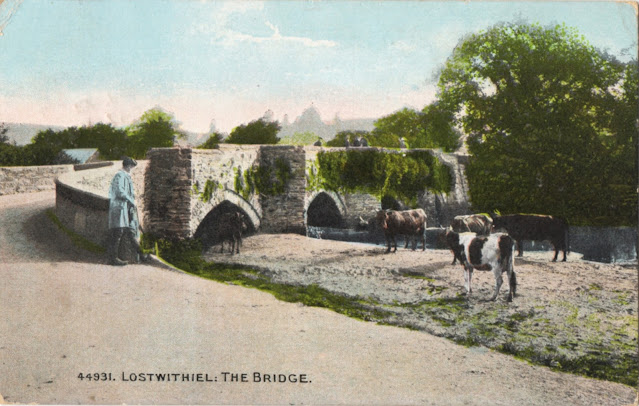
Our annual round up of bridges is again much reduced.  One of my favourite Cornish towns is Lostwithiel with its compact grid of narrow streets and a parish church that wouldn’t look out of place in Brittany.  Bypassed by history as the River Fowey silted up, robbing the town of its lucrative maritime trade and its status as the county town of Cornwall.  Fortunately it wasn’t bypassed by the Cornish Railway which linked it with the wider world and chose to build its principle workshop in the town. The workshops have been converted into apartments but the trains still stop. To reach the railway station, travellers must cross a narrow 15th. century Grade 1 listed stone built bridge over the River Fowey - pedestrians must take their chances with passing vehicles, often resorting to the triangular refuges built out over the piers that support the 5 arch structure. There’s a bucolic postcard from the early years of the last century for comparison.


 The second photo was taken in the Peak District at Monsal Head, a popular viewpoint overlooking  Monsal Dale and the valley of the Wye.  To the left is the Headstone Viaduct (Grade 2 listed), built by the Midland Railway in 1862-63, connecting Bakewell and Buxton to the great displeasure of John Ruskin. This train is about to enter Headstone Tunnel about which we posted in 2012. Trains no longer run and the trackbed now serves as a cycle route and public footpath. The postcard view is a shameless exercise in exaggeration presenting a locomotive inflated to many times its real size racing across a viaduct, in turn reduced to the scale of a modest footbridge. Absolutely guaranteed to offend Ruskin the Victorian snowflake.

Thursday, 29 April 2021

Bridges of Paris: 2 Pont de Bir-Hakeim

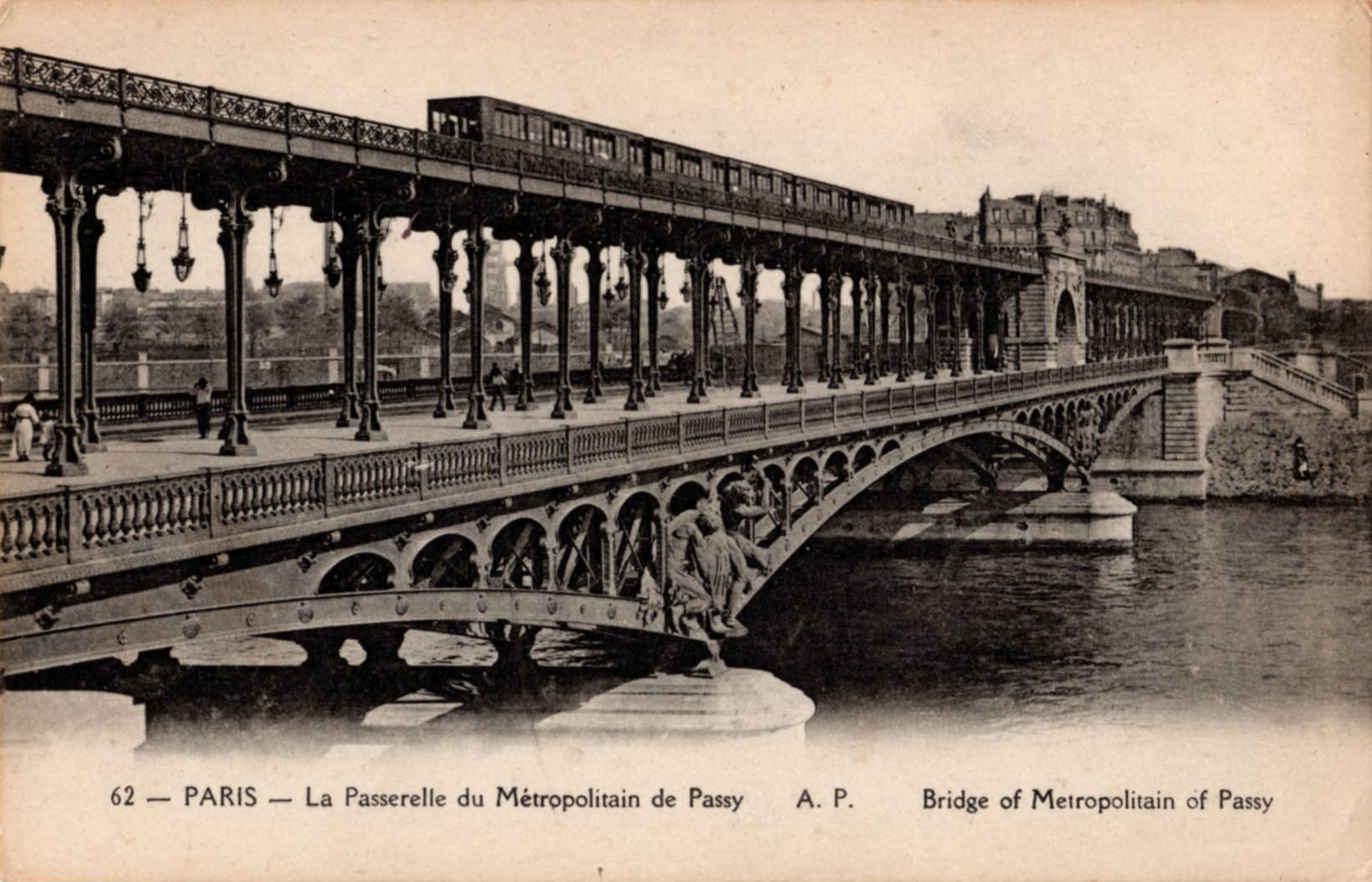
Pont de Bir-Hakeim links the Parisian districts of Passy (16th.) and Grenelle (15th.) and carries Métro line 6 over the Seine on one of two such crossings on its circuitous arc from Charles De Gaulle - Étoile in the west to Nation in the east. Approaching the Passy Métro station on rue de l’Alboni ends in a deep visual dive over the river Seine as if poised at the top of a ski slope.  From the railings at the end of the street the view takes in the platforms and canopies of Passy station and the ribbons of steel rail leading to the next station and beyond, deep into the 15th. arrondissement. Less obvious are the bridge abutments that mark the passage over the Seine which is the reason for this spectacular view opening up. 

The bridge itself is a two tier viaduct for road and rail (Métro) - in the centre of the roadway a pedestrian walkway and cycle route runs underneath the rail bridge.  The railway runs on a concrete deck supported by tall slender steel columns, each formed from four plate sections that taper and flare to make them easier on the eye. There’s more beautification in the form of Classical reliefs representing Electricity and Commerce on the stone built central arch. Additional sculptures grace the steel substructure where it rests on the stone pier of the Île aux Cygnes.  The bridge designer was Jean-Camille Formigé whose work can be seen all over the city on Métro infrastructure and the Viaduc d’Austerlitz. When the bridge was completed in 1905 it was known as the Viaduc de Passy – in 1948 it was renamed in honour of the Free French military victory at Bir-Hakeim in 1942.

The colonnade is a popular location for fashion photo-shoots and the bridge has made many appearances on screen, most notably in Zazie dans le Métro and Last Tango in Paris. The photos conclude with images of the elevated platforms at Métro Bir-Hakeim (formerly Quai de Grenelle).


Sunday, 18 April 2021

Postcard of the Day No. 103 Morlaix

A busy scene in the Breton market town of Morlaix where a narrow-gauge train operated by Chemins de Fer Armoricain, a metre-gauge network of lines built to connect small towns and neighbouring coastal settlements along the north coast of Finistère.  The Morlaix section opened in 1912 which may well be the year of the postcard. A group of women in Breton headdress are making their way into town, passing the modest but decoratively detailed station building, complete with édicule.  Above the train, the massive piers of a railway viaduct can be seen on its march across the steep sided valley in which the town is located.  What we see here is just the first level of the structure which has 9 arches - the upper level is more than 60 metres in height and has 14 arches.  Its presence is inescapable - it dominates the view from all districts of the town and must have been a hugely resented intrusion when it was under construction in 1861-63.  The lower level incorporated a pedestrian walkway but last time I was in Morlaix (more than 10 years ago) I discovered it locked and barred in a way that suggested it was unlikely to ever reopen.

After several years of construction the viaduct was fully opened in 1865 as a vital link in the main line from Paris to Brest operated by Chemins de Fer de l’Ouest. Today, up to 7 TGV services from Paris-Montparnasse cross overhead each day and the viaduct is protected as a national monument. These postcards are a reminder of how private commercial interests could transform a townscape that had evolved over many centuries by promising connectivity and future prosperity. At the same time public perception changes from outright hostility via gradual acceptance to popular veneration as a monument to engineering achievement.  The narrow-gauge railway was barely viable from the start and never generated enough traffic to pay its way - the convenience of delivering passengers to the heart of the town was offset by the lack of potential business in the sparsely populated hinterland. It closed for good in 1934 after only 22 years of service. Despite several visits to Morlaix over the years, I had no idea of its existence until I saw this postcard.