Showing posts with label bourneville. Show all posts

Tuesday, 27 May 2025

Bourneville 1925 Transport

Another Cadbury brochure published to explain the business of chocolate manufacturing to the general public, based on the notion that the public appetite for geography and economics was as great as the appetite for chocolate. A hundred years have passed since Frank Newbould was commissioned to provide the illustrations - a perfect choice given his expertise in transport and industrial process. Newbould’s cover combines road, rail and maritime traffic into a single composition, enhanced by an elevated viewpoint. Designed to impress with the unstoppable energy of commerce, Newbould has omitted any distracting details to focus on the triumph of mechanisation. There’s a map to show us the global presence of Cadbury, drawing in raw materials from every continent via a network of commercial shipping - what we would now call the mysteries of the supply chain. Export cargoes were nailed into wooden packing cases requiring enormous supplies of raw timber from Russia and Scandinavia, moved by rail to Bourneville to be machined in the company saw mills. Cocoa beans, sugar and hazel nuts were stuffed into sacks, that in turn were lashed into nets to be craned on and off mixed cargo ships.  Newbould shows an early stage in the travels of the cocoa bean where local labour loads heavy sacks into small boats that rendezvous out at sea with cargo liners too large to enter the port.  A fair weather vision of breezy skies and surf in which hard labour looks effortless.

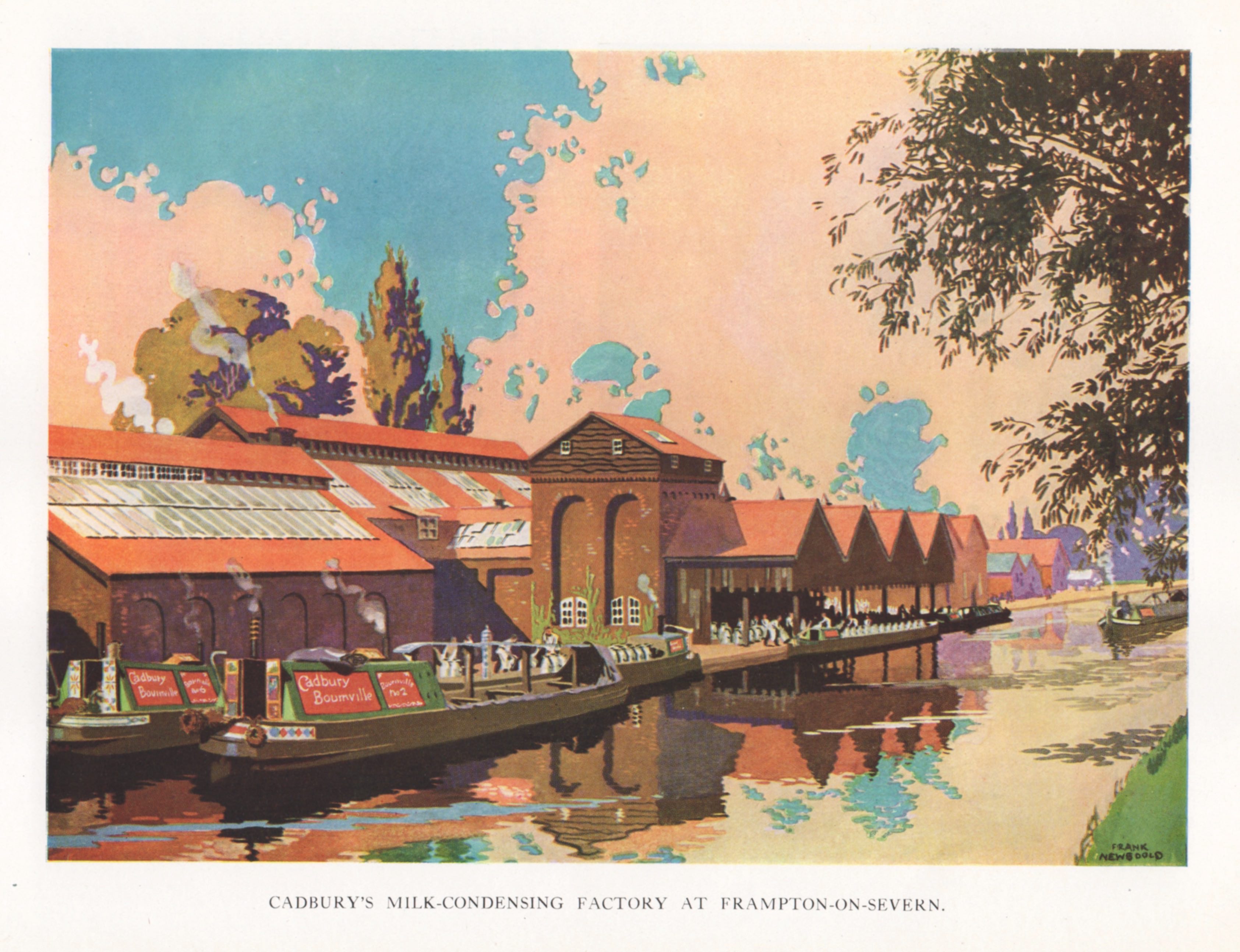
Equally idyllic is Newbould’s bucolic vision of a canal-side milk processing factory built in a restrained vernacular, barges and narrow-boats serenely chugging by. In a double page illustration across the centre pages, Newbould’s attention turns to the Bourneville factory in an aerial view that attempts to balance the vastness of raw industrial power with the sense of the factory cosily enveloped by the splendour of a verdant English countryside in high summer. To finish, Newbould observes the end of the process when the boxed finished products are loaded on to trains by sack truck and trolley.  The facility has all the features of a conventional station minus the passengers. Once again we are invited to admire the scale and complexity of operations thanks to Newbould’s control of colour to create a perfect sense of clarity. Cadbury invested heavily in a wide output of promotional publishing from collectors’ cards and albums to factory guides and brochures like this. Newbould was re-employed in 1927 and dispatched to Trinidad where he made a varied portfolio of location images that featured in Bourneville 1927, Cocoa Story. It can be seen in my post from August 2010.



Wednesday, 27 June 2018

Cadbury Century


When this commemorative brochure was published in 1931, chocolate manufacturers, Cadbury, had a very different relationship with their consumers than exists today. Successive generations of the Cadbury family had presided over the rapidly expanding business, exercising paternalistic control over an army of employees. As Victorians and Quakers they felt a sense of responsibility for the welfare of their workforce for whom they built homes and leisure facilities whilst encouraging a culture of sobriety and self-improvement. The second century was rather different and the family incrementally lost control and eventually, ownership of the business. Global capital took over and the connections with its Quaker origins evaporated.


Not sure how these prestigious brochures were distributed or whether copies went to members of the public or if they were confined to retailers or wholesalers but no expense was spared in the production values. Full colour illustrations throughout, many of them specially commissioned illustrations, and a textured card cover with embossing. The aim was very much to emphasise the continuity of the business and celebrate past achievements – with the onset of the Great Depression, there was little of substance about future plans. The power of our collective serotonin addiction ensures that the industry remains profitable. Cadbury battled for market share and absorbed several of its competitors to the point where further expansion became dependent on moving into other activities. From 1969 to 2008 it traded as Cadbury Schweppes before falling into the clutches of Mondelez in 2010. For Mondelez, Cadbury is just one of a vast portfolio of brands and as long as its performance targets are met, it will survive. If it loses its grip on the market, Mondelez has plenty of ammunition to fall back on – from its corporate HQ in the suburbs of Chicago it controls Toblerone, Suchard, Côte d’Or and Marabou, as well as Fry’s and Terry’s.


The brochure provides a fascinating review of the evolution of graphic styles in packaging and publicity – confectionery manufacturers competed for public attention with eye-catching wrappers and sustained campaigns across a wide range of media. This was the period when railway stations, football stadiums, public houses and High Street shops displayed an enormous gallery of enamel signs. This was followed by the rise of the poster – in the interwar years purpose built poster sites proliferated in town and city centres and suburbs along bus, tram and train routes. Chocolate makers made full use of these opportunities to get their message across. Some idyllic, fanciful views of the factory premises are included – a little steam engine, smartly turned out in company colours, puffs past with a trainload of company wagons on a perfect summer day. It’s the largest cocoa factory in the world, we are assured. The workers themselves are largely absent save for a picture of some white-coated female employees relaxing in a conspicuously sober and responsible fashion.


Wednesday, 4 August 2010

Bourneville 1927 Cocoa Story


Today we see how Frank Newbould (1887-1951), one of the greatest and most prolific of poster designers in the inter-war years, turned his talents to illustrating an instructional book for Cadbury’s, published in 1927. The visual idiom is the same as he employed on his work for the Empire Marketing Board – intense hues, strong tonal contrasts, all supported by beautifully observed drawing executed with flair. A little graphic wit is included where the artist notes the formal similarity between the small boats and the cocoa beans they are conveying. Newbould’s work has been featured here before and there are generous selections of his poster designs in the care of the National Railway Museum and London Transport Museum. The book itself is an example of a familiar type where a sober account of mercantile adventures in tropical territories is accompanied by exotic illustrations for the benefit of those children with limited capacity for the absorption of facts and figures.