Showing posts with label métro. Show all posts

Thursday, 29 April 2021

Bridges of Paris: 2 Pont de Bir-Hakeim

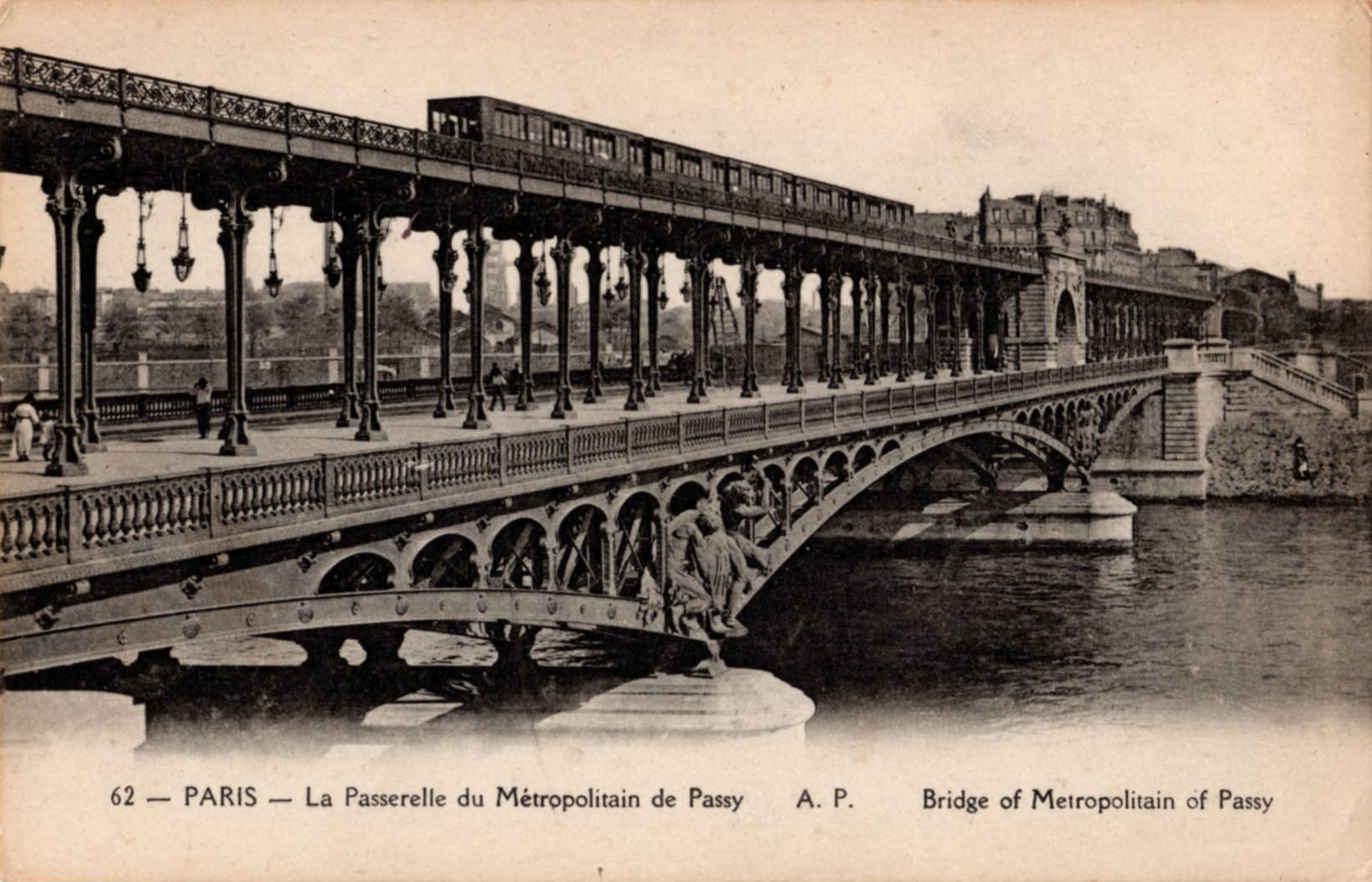
Pont de Bir-Hakeim links the Parisian districts of Passy (16th.) and Grenelle (15th.) and carries Métro line 6 over the Seine on one of two such crossings on its circuitous arc from Charles De Gaulle - Étoile in the west to Nation in the east. Approaching the Passy Métro station on rue de l’Alboni ends in a deep visual dive over the river Seine as if poised at the top of a ski slope.  From the railings at the end of the street the view takes in the platforms and canopies of Passy station and the ribbons of steel rail leading to the next station and beyond, deep into the 15th. arrondissement. Less obvious are the bridge abutments that mark the passage over the Seine which is the reason for this spectacular view opening up. 

The bridge itself is a two tier viaduct for road and rail (Métro) - in the centre of the roadway a pedestrian walkway and cycle route runs underneath the rail bridge.  The railway runs on a concrete deck supported by tall slender steel columns, each formed from four plate sections that taper and flare to make them easier on the eye. There’s more beautification in the form of Classical reliefs representing Electricity and Commerce on the stone built central arch. Additional sculptures grace the steel substructure where it rests on the stone pier of the Île aux Cygnes.  The bridge designer was Jean-Camille Formigé whose work can be seen all over the city on Métro infrastructure and the Viaduc d’Austerlitz. When the bridge was completed in 1905 it was known as the Viaduc de Passy – in 1948 it was renamed in honour of the Free French military victory at Bir-Hakeim in 1942.

The colonnade is a popular location for fashion photo-shoots and the bridge has made many appearances on screen, most notably in Zazie dans le Métro and Last Tango in Paris. The photos conclude with images of the elevated platforms at Métro Bir-Hakeim (formerly Quai de Grenelle).




Tuesday, 31 March 2015

Paris Métro Line 6


Métro Line 6 starts and finishes north of the Seine but for most of its length loops through the outer southern arrondissements flying high above the boulevards with intermittent subterranean descents. From east to west it begins underground at L’Etoile, emerging into the daylight at Passy before launching itself across the river on the Pont Bir-Hakeim. It follows a green corridor on a viaduct through the 15th. and 14th. until descending to tunnel beneath the Montparnasse district after which a second elevated section extends to Place d’Italie where it dips below ground again. Another rooftop glide leads via Quai de la Gare, recrossing the river at Pont de Bercy whence the line runs underground to Nation with only a brief burst of daylight at Bel-Air. 

Westbound train entering Bir Hakeim station

Line 6 as seen from the top of Tour Montparnasse


Aerial view of Sèvres Lecourbe station


Platforms at Quai de la Gare

Bel-Air where the train briefly surfaces

Tuesday, 16 September 2008

Métro Parisien


For anyone with recent experience of London Transport, the Paris Métro is a revelation. The average wait for a train during the working day is about 3 minutes. There is nowhere on the entire system where you can be faced with the sort of 20 minute service gap that occurs so often on the Circle Line in London. Trains are clean, brightly lit and spacious when compared with London’s “deep tube” trains. Rubber tyres are employed to produce a much smoother and quieter ride than conventional track. Other novelties include driver-less trains on line 14 and inter connected carriages on line 1 that enable the traveller to walk the length of the train. The Métro was built some 40 years after the development of London’s Metropolitan railway and the French had the advantage of learning from the structural problems that follow when two or more services share the same tracks. All 14 Métro lines are out and back shuttles though a few of them divide in the suburbs to serve more than one terminus.


The great age of London Transport (LT) came between the wars when Frank Pick created and developed a design-led network in which all aspects of operation were subject to a co-ordinated design process. In two respects LT achieved standards of excellence that the Métro never did, namely, posters and publicity and station architecture. To be fair to Paris, there are virtually no street level station buildings, access being via clearly signed staircases. The elevated sections are served by undistinguished elevated stations with either platform canopies or all-over roofs. The only areas where design played a significant part were the station interiors at platform level and the signage at the station entrances. There is no other graphic tradition and in the matter of graphic design and illustration for advertising London wins hands down.


Branding distinction has been achieved by careful preservation of the Art Nouveau derived designs of Hector Guimaud. Some of Guimaud’s finest achievements were destroyed in the years when Art Nouveau bottomed out in terms of public esteem but since the 1960’s the Guimaud heritage has been assiduously cultivated and replicated to the point where it now stands in the first rank of Parisian icons. Organic letterforms and twisting plant-like cast iron structures all contribute. The bizarre candelabras that loom owlishly over many an entrance have an almost sinister presence. Insect-like hooded light fixtures complete the picture.


Below street level the station platforms have been graced by a succession of ceramic-based decorative schemes that over the decades have been covered over in pursuit of a more contemporary acrylic-panelling look and then later reinstated and restored to their former glory. There have been a number of prestige projects to develop themed station decor (Louvre-Rivoli, Concorde, Bastille, Assemblée Nationale) but in central Paris at least, ceramic tiling remains the order of the day. The holy grail for connoisseurs of Métro architecture is the long closed station of Saint-Martin where a series of hoarding sized ceramic tiled advertisements have survived intact from the 1940’s. Urban Explorers have penetrated the security to gain access and photographs of their discoveries can be seen by following this link.