Showing posts with label book illustration. Show all posts

Friday, 8 August 2025

Ludgate Circus in Illustration and Postcard

This unsigned illustration comes from an Ernest Nister illustrated children’s book, The Scrapbook of Trains (c.1900). An atmospheric rendering of a busy Victorian street scene populated by some unconvincing rigid figures. When the railway bridge in these views was constructed in 1865 there was a storm of protest from the Victorian public angry at losing the view of St Paul’s up Ludgate Hill. All to enable the London, Chatham & Dover Railway to extend its services into the City of London. The line formed a link with the Metropolitan Railway near Farringdon and much later was used by Thameslink for cross-London services. Ludgate was one of the 6 gates in Roman London’s city wall. The bridge came down in 1990 when the Thameslink tunnel was completed, thus restoring the lost view of St. Paul’s after 125 years.

The King Lud pub (left) opened in 1870 and would finally close after various changes of identity in 2005 - the building remains and the ground floor is occupied by a Leon restaurant. Among a number of reminiscences on the Closed Pubs website is a recollection of a lively performance by the famous Blues piano player Champion Jack Dupree. A minority of the many postcard views have chosen to capture the scene at ground level but most opted for an aerial view from the upper floors of neighbouring buildings - a few waited for a train to pass over the bridge. Businesses come and go, advertising signs are repainted while horse drawn buses are replaced by petrol driven vehicles. An archive search of commercial and property directories might enable them to be assembled in chronological order. To nobody’s surprise, when the bridge was demolished, for every voice greeting the newly restored sightline to St. Pauls, another was deploring the loss of a ‘much loved’ bridge.

There’s a fine contemporary diatribe quoted below that John Ruskin would have been proud of.


Of all the eyesores of modern London, surely the most hideous is the Ludgate Hill Viaduct– that enormous flat iron that lies across the chest of Ludgate Hill like a bar of metal on the breast of a wretch in a torture-chamber.

Let us hope that a time will come when all designs for City improvements will be compelled to endure the scrutiny and win the approval of a committee of taste. The useful and the beautiful must not for ever be divorced. The railway bridge lies flat across the street, only eighteen feet above the roadway, and is a miracle of clumsy and stubborn ugliness, entirely spoiling the approach to one of the finest buildings in London.

The five girders of wrought iron cross the street, here only forty-two feet wide, and the span is sixty feet, in order to allow of future enlargement of the street. Absurd lattice-work, decorative brackets, bronze armorial medallions, and gas lanterns and standards, form a combination that only the unsettled and imitative art of the ruthless nineteenth century could have put together. Think of what the Egyptians in the times of the Pharaohs did with granite! and observe what we Englishmen of the present day do with iron. Observe this vulgar daubing of brown paint and barbaric gilding, and think of what the Moors did with colour in the courts of the Alhambra!

A viaduct was necessary, we allow, but such a viaduct even the architect of the National Gallery would have shuddered at. The difficulties, we however allow, were great. The London, Chatham, and Dover, eager for dividends, was bent on wedding the Metropolitan Railway near Smithfield; but how could the hands of the affianced couple be joined? If there was no viaduct, there must be a tunnel.

Now, the bank of the river being a very short distance from Smithfield, a very steep and dangerous gradient would have been required to effect the junction. Moreover, had the line been carried under Ludgate Hill, there must have been a slight detour to ease the ascent, the cost of which detour would have been enormous. The tunnel proposed would have involved the destruction of a few trifles –such, for instance, as Apothecaries' Hall, the churchyard adjoining, the Times printing office– besides doing injury to the foundations of St. Martin's Church, the Old Bailey Sessions House, and Newgate.

Moreover, no station would have been possible between the Thames and Smithfield. The puzzled inhabitants, therefore, ended in despair by giving evidence in favour of the viaduct. The stolid hammermen went to work, and the iron nightmare was set up in all its Babylonian hideousness."


Wednesday, 12 March 2025

Alphabet Books - ABC du Père Castor

For an illustrator a pictorial alphabet book presents a number of challenges, not least of which is the shortage of words beginning with q, x and z. Today’s example follows a thematic approach based on wild animals - a popular approach that focuses on groupings such as Flora, Fauna, Aquatic Life, Astronomy, Travel etc.  Père Castor illustrated books for children first appeared in France in the 1930s, English language versions were published by George, Allen and Unwin after the war in a series of 8 as Père Castor’s Wild Animal Books. In each volume the lively illustrations are the work of Latvian born illustrator, Feodor Rojankovsky (1891-1970), known professionally as Rojan.  Born as a Russian citizen and educated in St. Petersburg, he was conscripted into the White Army in 1919 and ended up as a p-o-w in Poland, by 1922 he was officially stateless. He found his way to Paris in 1925 and established himself as a commercial illustrator with a speciality in expensively produced volumes of suavely visualised erotic encounters before finding a niche in the world of books for children.  The drawings he produced for the Père Castor series have a wonderful sense of spontaneity achieved by a rich tonal range of closely controlled mark making on lithographic plates. As the blurb on the back of one volume nicely puts it - the book is “gently ablaze with Rojan’s lithographs”.  After arriving in the US in 1941 he began an almost 30 year career as an illustrator for children’s books.

Rojan’s cover design is a minor compositional triumph I can’t recall seeing elsewhere. The group of animals on the front cover are drawn again on the back as if viewed from behind. Each creature has a page to itself with the only exceptions at the end of the alphabet (from w to z) to cope with the limitations imposed by the problematic number of 26 letters. The placing on the page and the lightness of touch are a delight throughout the book. Another alphabet book (Off By Train) can be seen by following this link. The last image is my collection of Père Castor Wild Animal books.


Sunday, 3 November 2024

Leslie Carr illustrates "By Road, Rail, Air and Sea" (1931)

Fourteen years have passed since I last wrote about the illustrator and poster artist, Leslie Carr and noted the lack of online biographical information. That situation has changed and a lot more detail has emerged about his life and work. We now know he died in the town of his birth, Hove, in 1969 and in his last decade was employed as Art Director for The Motor magazine. In the First World War he served in the Tank Corps and during the Second World War he was a member of the Auxiliary Fire Service. Carr painted a series of paintings of wartime subjects based on his experiences, one of which sold at auction in 2018 for £16,000 after a pre-sale estimate of £200 to £400.

Today’s images come from a Blackie picture book for children published in 1931 titled By Road, Rail, Air and Sea for which Carr supplied the cover art and the majority of illustrations. The cover is a busy dockside scene in which all four transport types are combined in a single image in which areas of unmodified colour are enclosed by crisply incisive contours. In the spirit of the time he mostly employs a sachplakat style, to which he occasionally (and sometimes incongruously) adds some vigorous cross-hatching. Drawings are considered and precise with a subtle and inventive colour palette and at their most radical (the paddle-steamer) display a near-Japanese quality of repose. Examples of his poster work can be seen at Art UK and the Science and Society Picture Library.


Tuesday, 28 November 2023

Walt Disney’s Family Album (1937)

It’s impossible to over estimate the extent to which the emotional life of every child exposed to the output of the Disney Corporation is formed and shaped to create an insatiable demand for the irresistible embrace of the Disney Universe. For almost a century, children have been at the centre of what has grown into a global grooming project as an entertainment portfolio that began with the moving image has expanded to include mass merchandising, retail stores, theme parks and dedicated streaming services.  There’s an acute understanding of the juvenile appetite for sentiment and spectacle layered over eternal themes of sibling rivalry, jealousy, cruelty, suffering and redemption.  Every feature is attached to a bulging package of ancillaries - models, dolls, princess costumes, soundtracks, illustrated books, sticker collections, action figures, backpacks, board games, stationery and customised clothing - entirely designed to separate fools from their money. It’s a massive corporate presence that generates enormous revenue streams and yet, despite this long performative diatribe, two things must be conceded.  To begin, some of the products are undeniably ingenious, amusing, sensitive, compassionate and offer cunningly contrived entertainment that can be appreciated on many levels, enough to undermine the most curmudgeonly resistance.  And secondly, with very little effort, the company has roused the intemperate fury of the ineffable Ron DeSantis, Governor of Florida, triggering a feud that is currently grinding its way through the US legal system.

All this was a long time in the future when this book was published in 1937.  The colour illustrations were supplied in the form of stickers to be pasted in the book by the young reader. The star of the book was only 9 years old but the process of brand characterisation was well underway. Disney’s first full length feature (Snow White and the Seven Dwarfs) released at the end of 1937 marked the emergence of Disney as a major studio, even so, dreams of future world domination would have seemed implausible in those early days. But it was the end of the Disney age of innocence and a sign of what was to come.


Wednesday, 22 November 2023

T E North on the High Seas

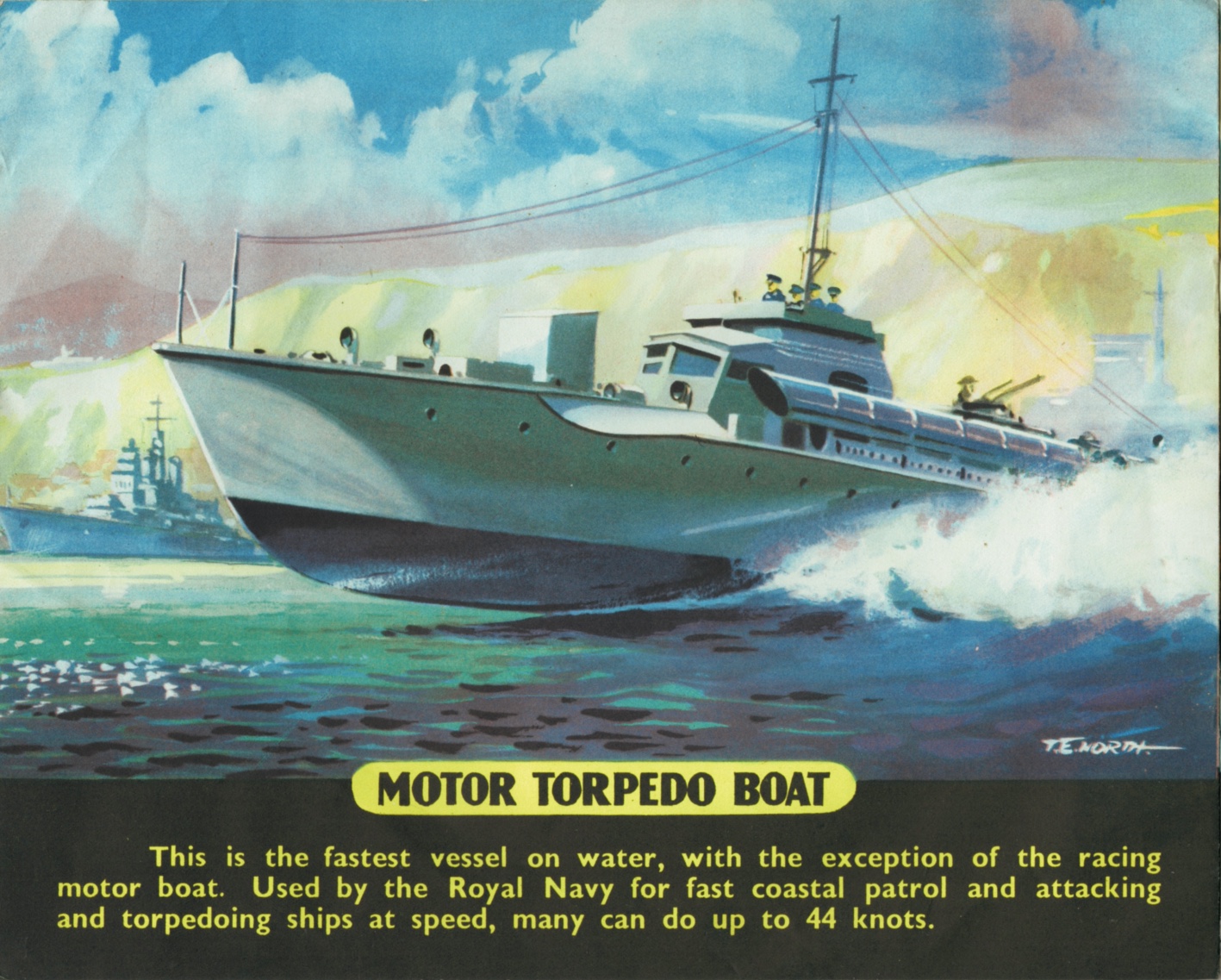
The book illustrations of T E North were featured here a few months ago when we posted about an aviation picture book (Airways) published in 1939.  Notable for compositional originality and precision drawing, the qualities displayed in Airways faded in his post-war output in line with contemporary trends.  After 6 years of war during which he served in the RAF, rebuilding his career and adapting to a much changed commercial situation would have been difficult. The services of an assiduous agent would have been essential and it may have been an agent who spotted his affinity for transport subjects and marketed his skills to publishers. Appropriately for an artist born and bred in Hull this example is a book of maritime illustrations for young people. Atmospheric effects predominate, brought to life by more gestural brushwork and a dramatically intensified colour palette.  Perhaps the romance of the age of the great ocean liners and the cargo ship demanded a more vigorous approach.  Recent collective memory of war fought at sea and the prestige invested in building ever larger and more luxurious liners fixed all things maritime firmly in the mid-century popular imagination in a way that’s inconceivable today.  The image of the ship’s captain was a figure of steely resolve, commanding the loyalty of the crew in the face of danger from the elemental terrors of hostile seas. Young readers could be enthralled by the exotic network of international shipping, at the centre of which they were assured, Britain stood supreme and unchallenged - a supremacy that evaporated at breathtaking speed over the next decade as the nation first decolonised and later de-industrialised. 


Thursday, 31 August 2023

Airways 1939

This is a slim pictorial board covered, large format picture book for children published by Blackie in 1939. There are 13 colour illustrations (including the cover) and most of them bear the signature of T E North who has been identified as Thomas Edward North (1916-1985), a lifelong resident of Hull - his career has been well documented at Bear Alley Books. Airways is the earliest example of his illustration work I’ve seen, all the more remarkable for having been produced at the age of 23.  How North broke into the world of book illustration is an unknown story but he did well to find his work published by the illustrious firm of Blackie. Unlike most of his contemporaries, North was unafraid to experiment with unusual angles and unorthodox compositions in search of visual dynamics.  There’s a formal crispness and clarity that wouldn’t be seen in his post-war production.  When his career resumed after war service in the RAF he seems to have specialised in transport related material in ever smaller formats, mass produced pocket sized books for children. The illustration style is conventional for the period - descriptive but nothing more. At the end are two examples of card covered illustrated books and a jigsaw - whether the latter were based on new material or recycled images from books would be interesting to know.