Tuesday, 17 December 2013

Christmas 1946


It looks like being a Wonga Christmas here in Britain. Blizzards of iPads and Play Station 4s will blanket the land, mostly paid for with payday loans or compensation payments for PPI mis-selling. Television remains the principle engine of consumption, alternately flattering, imploring or deceiving the viewers into parting with far more cash than they actually possess in order to give every appearance of boundless munificence. Looking back to the pages of Saturday Evening Posts from December 1946 we find that advertisers were deploying many of the techniques of persuasion that survive to this day as they scrap for a share of all the excess dollars that swill around every December. The example above from the insurance industry cultivates the sense of high anxiety and desperation that typifies Christmas for many. Tis the Season for Litigation – all the perils of Christmas cheer are graphically described here. Who hasn’t brained their neighbour with a snow shovel or entertained their guests with collapsing chairs? Compensation culture was already in full swing in 1946 America. Gift suggestions form the larger part of these ads and Christmas imagery is prominent. Where Santa puts in a personal appearance, the illustrators struggled to achieve a consistent standard of joviality and some distinctly ambiguous facial expressions can be seen. The tobacco industry was in its full majesty, marketing a wide range of gift packs and suborning the medical profession to testify to the benefits of smoking. A singular curiosity is the absence of alcoholic drink advertising, suggesting that the Post reader of 1946 was an abstemious creature, unwilling to see their favourite reading matter contaminated by publicity for the Devil’s cocktails. 


The railroads and airlines battle for supremacy in the “We get ’em home” category. The airlines would decisively win the battle in the next decade.


Attractive gift packs and a recommendation from the family doctor would surely be enough to eliminate any lingering health doubts on the part of smokers.


For men – shirts, ties, socks and pens, and for the lucky, lucky lady in your life, a shiny new Never-lift electric iron. Housework has never been so much fun.


The full-page Santas often had an unsettling air of menace about them.


Food and drink promotions relied on tableaux of seasonal euphoria, although Campbell’s Soup went for a less elevating message stressing the convenience of the product.


The home comforts and safety category was a brave attempt to sell some banal products by linking them to seasonal extravagance.

The man who covets a Higgins Camp Trailer may have unrealistic expectations but who could fail to be tempted by the graphic representation of such a thrilling range of activities?

Thursday, 12 December 2013

Pennsylvania Railroad Serving the Nation


There’s an entertaining case-study in Roland Marchan’s Creating the Corporate Soul (1998) on the subject of the Pennsylvania Railroad (PRR) and its pioneering enthusiasm for the devious art of public relations. Second only to the New York Central in terms of passenger numbers, the railroad was unloved by both customers and employees according to an opinion survey it commissioned in 1926. Travellers were unimpressed by singularly unhelpful and discourteous staff while the workforce was confronted by an employer hostile to unions and bent on reducing wages and pensions. To break this vicious cycle, a campaign was launched with the aim of raising employee performance by celebrating instances of exceptional assistance rendered or displays of outstanding courtesy (both actual and fictional) in magazine advertising and internal newsletters. Nothing less than a corporate spirit of virtuous service would suffice. A wedge was driven between the workers and their union by assiduously promoting a company employee association. Another company ambition was to develop a close relationship with all the small communities served by its network and convince the populace that despite its monolithic scale, at heart it was a small business like any other that only existed to serve the needs and desires of ordinary folks. Every bit of publicity was designed to reinforce the notion that the PRR possessed a heart and soul dedicated at every level to the welfare and happiness of its customers. This campaign was regarded as an exemplar by the infant public relations industry but as Marchan points out, there was no conclusive evaluation of the results and such indications as there are suggest it accomplished very little. By 1933 some 67,000 workers had been laid off and the remainder casualised and an industry expert is quoted saying that the PRR was “easily the most hated railroad and General Atterbury (company president) the most hated railroad executive”. 


From 1941 the priority was to demonstrate the company’s resolute commitment to serving the military campaign – every freight train carried essential supplies and munitions and every passenger train conveyed troops to their point of embarkation. Public morale was boosted by restating the fundamental values of American greatness, elevating vast clouds of patriotic fervour into the upper atmosphere alongside the smoke from the locomotives. The rewards of victory were held out, offering a return to an era of peace and plenty to sustain the public through the privations of war. Every operational aspect was reconfigured to save waste and improve efficiency and then reported to the public via mass circulation magazine advertising. Copy was written to personalise the PRR and communicate in the voice of a concerned citizen, gently reminding the readers that all essential supplies, raw materials, power, light, energy, food etc. were dependent on the activities of the railroad. Blue-collar and white-collar put aside their differences and united in the national interest. 


When peace returned there was a focus on rebuilding the infrastructure although the deeper message was to enlist support for the campaign for tax breaks. New improved coaches offered passengers enhanced space and comfort while new freight wagons destined to transform industrial efficiency rolled off the production lines to be waved on their way by enthusiastic small boys. Then there was the moment when the military uniform was set aside in favour of a return to the railroad blue, a transition celebrated in an ecstatic hyper-real tableau that captures the resumption of peacetime normality in an effort to reinforce esprit-de-corps. Molly Pitcher was doubtless sent packing as other servicemen returned to reclaim their former positions. The sunny prospects of vacation travel replaced the exigencies of wartime that demanded that every passenger train was shown passing through an industrial underworld beneath glowering apocalyptic skies. Despite the gleaming new trains with their recreation cars, the convenience and superior speed of airlines were rapidly stealing the customers away. When the network of interstate highways was complete, the end came quickly and in 1968 the PRR was merged out of existence. 


Friday, 6 December 2013

Postcard of the Day No. 61, Albulabahn


We seem to be faced here with a scene from a mediocre and depressing comic opera set in the Swiss Alps. It looks like the moment when a passing prosperous lederhosen-clad traveller pauses to get his glass of local wine refilled by the innkeeper’s wife while an unprepossessing agricultural labourer looks on in silent resentment. But what brings the image to life is the magnificently irrelevant presence in the distance of a tiny train lead by two locomotives, blasting its way uphill with copious clouds of smoke and steam trailing behind. The horse and cart represent old technology while the railway viaducts that scale the mountainside are a triumph of the most advanced civil engineering. The card is a pleasing addition to the select group of postcards that feature a wheelbarrow. The spectacular Albula railway was constructed between 1898 and 1903 and since 2008 has been a UNESCO World Heritage Site. There are 55 bridges and 39 tunnels over its 39 mile length. To conclude we offer a further selection of cards in which trains can be seen crossing bridges.


Tuesday, 3 December 2013

Whilst We Sleep with Typhoo Tea


This is a series of 25 collectors’ cards issued in 1928 by Typhoo Tea. It’s a tribute to the anonymous individuals who keep us safe and ensure the wheels of commerce keep turning throughout the night. We are presented with a sober law-abiding group, responsibly and purposefully occupied in the interests of an orderly productive society. So, no place for the courtesan, the croupier or the cat burglar. Most of these worthy folk would today be working for Serco or G4S on Zero Hours contracts, clad in Hi Vis jackets. Today’s Pantheon of Heroes of the Night would have to include the office cleaner, the Paramedic, the Amazon order picker, the all-night DJ, and the Samaritans volunteer. The images are ideally suited to the elongated vertical format designed to fit inside a packet of tea and, unlike cigarette cards could be collected without exposure to the health risks associated with smoking. 


Sunday, 1 December 2013

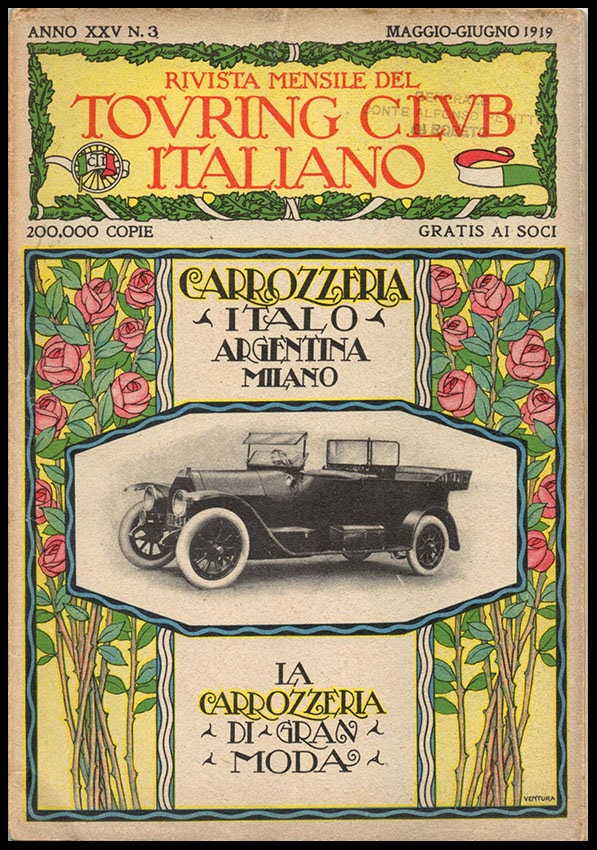
Italia Grafica


Italy was slow to adopt the poster form of advertising and when Les Maîtres de l’Affiche publication was complete in 1900 there were only 3 examples from Italy out of a total of 256. Although Italian graphic arts never quite acquired the distinctive national flavour or global influence of the French, German or Swiss traditions there were many fine artists and illustrators whose work combined visual wit with a directness of approach. These images come from 1919-20 when the most influential Italian illustrator for advertising was the incomparable Cappiello (who largely lived and worked in France). The Cappiello style of an arresting, gently humorous central image and a detailed portrayal of the product package against a flat colour ground can be seen in Italian advertising as late as the 1960s. What we see here include some examples from an earlier Art Nouveau influenced genre as well as some robust examples of the Cappiello tradition.