A postcard trip around Paris with Chocolat-Menier, France’s best known chocolate brand. There’s a Menier-related feature smuggled into every example of these promotional items. It might be a poster, a delivery vehicle, an illuminated sign or a Morris column. The views are usually conventional tourist hotspots with an occasional diversion to lesser attractions such as the cattle market at La Villette or Place Daumesnil. They are hand-painted in a casual brushy style with a taste for dramatic weather effects and night skies. Over a hundred were issued in the series which expanded to include les Environs de Paris. For a description of a visit to the Usine Menier at Noisiel, please follow this link.
Thursday, 20 July 2017
Monday, 17 July 2017
Once Upon a Time in Dortmund
Zeche Zollern is a carefully preserved industrial site to the north of Dortmund that has the distinction of being Europe’s only Art Nouveau/Jugendstil colliery. Stepping from the train at Dortmund-Bövinghausen, I myopically missed all the directional signage and set off in the wrong direction. My walk took me round all four sides of a large rectangle until arriving back where I started. This time the signs were unmistakeable and the rest of the journey, uneventful. Flags, bunting and banners announced my destination, which is more than I usually expect. And the sounds of fairground organs and steam engine whistles suggested an event was underway.
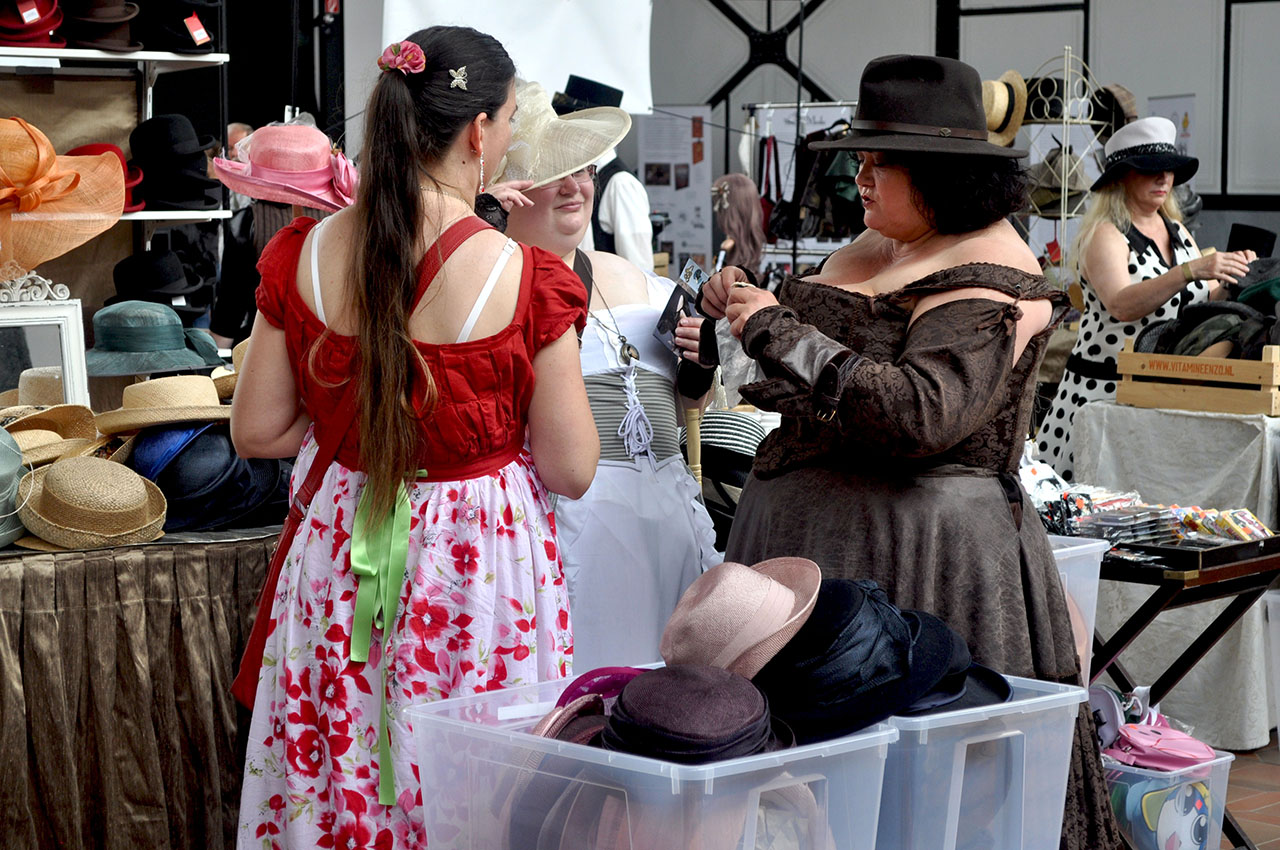
Inside the colliery site was a flurry of activity graced with top hats, fishnet tights, goggles, compasses and pocket watches. An ancient steam road roller and a brace of traction engines were on hand accompanied by the hiss of escaping steam. Stilt walkers and penny farthing cyclists meandered around the site. Recently returned big-game hunters, grouse-shooters and polar explorers mingled with the crowd. Dr. Marrax prepared to bamboozle his audience with a miracle cure – assisted by some mandrake root and assorted paraphernalia. Carousels were in full swing and the Flea Circus was open for business.
Steampunk is one of many minority cults that came into existence without me really noticing – to me it looks like a marriage between Gothic and High Victorian Heavy Engineering. It seems remarkably unthreatening and congenial and, to my knowledge, there are no records of Steampunk hate crimes or civil disorder. The choice of venue for a Steampunk gathering, titled “Once Upon a Time”, was perfect – no better place than a cluster of over-elaborate post-industrial relics.
Zeche Zollern was a prestige project from its inception in1898. Prominent Berlin architect, Bruno Möhring (1863-1929) was engaged and produced an opulent Jugendstil styled series of surface buildings. Most famously the Machine Hall with its stained glass entrance that originally included a Hector Guimard-style aedicule (now lost). The colliery was closed in 1966 and narrowly avoided demolition. Since then it has been extensively restored as a historic industrial relic and a site for cultural events. It was the industrial relic that attracted my interest and the Steampunk event was initially an unwanted distraction. My preference is for minimal human presence in my photographs but, bowing to the inevitable, I tried my hand at documentary photography with mixed results as seen here.
Labels:
art nouveau,
colliery,
dortmund,
funfair,
Germany,
heritage industry,
industry,
jugendstil,
ruhr,
ruhrgebiet,
steampunk,
zeche zollern
Wednesday, 28 June 2017
Ruhrgebiet in Close-up
The photos here were taken on a recent visit to the Ruhr – following the Industrial Heritage Trail. When the impact of globalisation and cheap foreign imports of coal, iron and steel products destroyed the viability of mining and heavy industry in the 1980s and 1990s, de-industrialisation rapidly took place. The local authority’s response was to preserve the most impressive industrial sites and open them to the public as educational and recreational resources. These photos come from Duisburg, Essen, Bochum and Dortmund. In close-up these structures offer compositions that in colour, surface and mass often resemble the sort of abstract formalism that can be found gracing the walls of Modernist art museums. It’s a conceit of course – the appearance of these structures was entirely dictated by their utility. The aesthetic input was zero. It is artists and photographers who have developed an aesthetic response to industrial spectacle and created the concept of the Industrial Sublime. A list of the guilty parties would be long and certainly include Charles Sheeler, Carl Grossberg, Albert Renger-Patszch and Bernd and Hilla Becher.
Sunday, 25 June 2017
Road Surfacing 1909
Parisian highway maintenance – a sightseeing tour around the city with added work gangs. Much back breaking manual labour – levering paving slabs, spreading bitumen and laying cobblestones. No hi-vis clothing and no steel toecaps and tasks that, to this day are often carried out by hand. It’s a refreshing way to visit the City of Light. Cards issued by Liebig in 1909.
Labels:
1909,
illustration,
liebig,
paris,
trade cards
Monday, 19 June 2017
Cork Flooring
The High Altar in the apse at St. Fin Barre’s Cathedral in Cork rests on a mosaic floor designed by William Burges. Crustaceans, molluscs and amphibians in mosaic form share the space with artisans, scholars and parfait knights. The initial inspiration for this piscatorial fantasy came from St. Matthew, “.... the kingdom of Heaven is like unto a net that was cast into the sea and gathered of every kind”. There’s a useful account of the mosaics in J Mordaunt Crook’s William Burges and the High Victorian Dream – Crook is well disposed toward the mosaics but clearly regards them as a minor aspect of Burges’s achievement. Crook tells how they were manufactured in 1877 by Burke & Co. in Paris by a team of Italian craft-workers from Udine using Pyrenean marble fragments. The imagery has a light and playful character that is not something routinely found in a High Anglican place of worship but one of Burges’s many redeeming features was an appetite for fun and a liking for puns. The latter inspired him to include bobbing corks (unfortunately not visible in this selection) in his aquatic fantasia.
Labels:
1877,
architectural ceramics,
architecture,
cathedral,
church architecture,
cork,
gothic,
ireland,
mosaic,
victorian,
william burges
Thursday, 15 June 2017
Streetcar Propaganda
At first glance these postcards seem to be an expression of an aesthetic impulse to embellish the harsh rectilinear forms of a streetcar with the soft and organic forms of floral decoration. Japanese visual culture places the highest value on refinement but something else appears to be going on here. More sinister and militaristic imagery appears on closer inspection, alongside a profusion of national flags and naval ensigns. Airplane cut-outs could be taken as celebrations of technology but there’s no ambiguity about the slender forms of falling bombs. A formidable armoury has been deployed in floral disguise including aircraft propellers, torpedoes and artillery. The best guess is that this is a souvenir of a morale-raising street procession to remind the local populace of their patriotic duty to submit to the war effort. Which would date these postcards to the early 1940s.
Labels:
japan,
patriotism,
postcards,
propaganda,
streetcars,
trams,
war,
world war 2
Subscribe to:
Posts (Atom)