Wednesday, 20 May 2020

By Coach to France 1938


This is from a holiday scrapbook recording a coach trip to France and Switzerland in May 1938. Luggage labels mark the route taken. The happy travellers can be seen, lined up for a photograph en route - the group leader is in the centre - he is described as a professor of English from the Sorbonne, a fluent linguist and “possessed of a first class knowledge of the history of France”. Missing is the photographer and chronicler of the trip. He’s an articulate observer of rural life and the natural world. When recording his impressions of human behaviour, he favours a sardonic tone that shades into pomposity and, on occasion, downright misanthropy, nowhere more so than when commenting on the physical imperfections of the ageing dowagers of Aix les Bains at their leisure in the casino. Orléans is a source of irritation - constant reminders of England’s defeat at the hands of Jeanne d’Arc overshadow the pleasure of a superb lunch at the Grand Hotel d’Aignan. Despite being a “port city”, Bordeaux meets with approval. Half the hotels in Biarritz are closed due the Spanish Civil War. At the Hotel de France in Pau they were served with the “finest lunch in all France”. The scale and mass of the fortified city of Carcassonne “impressed itself in detail more permanently upon our recollection than any other place we visited”. Nightingale song is heard in Avignon but Provence is too hot for comfort. In Geneva there was “a tablet to the memory of Woodrow Wilson, the man who fashioned the boat of peace and wouldn’t row”. Swiss pluralism is commended thus, “Happy is the state which has the genius to keep the demon of racial intolerance at arm’s length”. There’s an opportunity to do some snowballing in the heights of the Jura but all too soon the coach is back at Calais after overnight stops in Vittel and Amiens. A three hour crossing to Dover in storm force winds followed by a traffic jam in Kent concluded the trip and the participants went their separate ways with scarcely a mumbled farewell.


Sunday, 17 May 2020

Postcard of the Day No. 99 - Poker Game


Today’s card was produced by the Detroit Photographic Company, early pioneers of the colour printed postcard. Large glass negatives were used to gather their images and they are famous for the amount of detail they captured. There are about 50 men in the room, not one is bareheaded, and most are spectators. Two games are in progress and among the players are a few of Asian origin. Standing out from the crowd is the one man sporting a white hat. We can be certain the card was published no earlier than 1905. Not an especially refined group of men, the evidence suggests it may be somewhere in Northern California with San Francisco the obvious candidate. The contrast with the expensively dressed haut-monde floating between the roulette tables of Monte Carlo on clouds of privilege could hardly be more stark.


Being notoriously risk-averse, the allure of gambling has passed me by. So this selection of postcards celebrates an activity with which I feel no affinity. This is not a claim for moral superiority - lack of susceptibility to a single vice is no guarantee of universal abstention. The psychology of gambling holds much fascination and it seems that economic status makes very little difference - rich and poor alike can be seized by gambling fever. Poverty is a great driver for the gambling industry in marketing the attractions of life-changing sums of money in return for very modest stakes. If I was involved in the business, I would be actively lobbying the government of the day to create more and more poverty to build the customer base on human desperation. At a local level, the industry sucks value out of already impoverished communities, thereby intensifying the deprivation on which their profit margins depend. Where the rich are concerned, it’s more complicated. The prospect of unearned wealth can hardly motivate when a rentier economy offers generous risk free returns to any substantial property owner. But the possibility of an instant descent into penury on the throw of a dice or a handful of playing cards can act as a powerful stimulant, opening a neural pathway to those regions of the brain where the most intensive pleasure centres lurk.


Recent decades have seen the gambling industry expand as regulations have been rolled back. Moving business on to online platforms made gambling a 24/7 opportunity while televised sporting events all came with an invitation to wager on the outcome in every ad break. The less privileged punter is catered to by a variety of branded outlets embedded on every high street between the charity shops, tanning salons, nail bars and tattooists. Austere premises equipped with Fixed Odds Betting Terminals offering another unlikely route to untold riches while in some distant county town, a troop of horses and riders complete the required number of circuits. Casinos operate to a number of class-based formats, those at the bottom being open to all, irrespective of income, pedigree or the possession of an appropriate wardrobe. Witness the informal leisurewear and nervous expressions around the Wheel of Fortune in Las Vegas. At the apex of the social pyramid, class signifiers are everything - sumptuous furnishings and an exclusive dress code keep the riff-raff at bay. Glamorous hostesses skilled in the arts of flattery, and copious quantities of alcohol numb the senses and muddle the brain, encouraging even the most cautious punter to think they can beat the house. Hollywood producers have always loved a gambling based plot and often present us with a hero who panics the house while walking away with a fortune. In reality, if the profits of the major betting businesses are any guide, the house doesn’t just win, it annihilates.


Thursday, 14 May 2020

Pumping Gas


When Stevan Dohanos painted a monumental vision of a Wayne Gas Pump for a feature in Fortune magazine in 1937, he knew exactly what he was doing. In a restless nation founded and built on mobility, the filling station supplied the lifeblood of internal combustion without which the Southern Diaspora and the Dustbowl Migration might never have happened. The essential agent of distribution was the gasoline pump and Dohanos already had a sense of its mythic importance and transformational power. Acquisition of a motor car was the first duty of the American citizen and the ability to travel at will rapidly evolved into a fundamental human freedom. A massive carved gas pump would not have looked out of place on Mount Rushmore. Neolithic civilisation provided Europe with a vast network of standing stones - America got the gas pump. The founding fortunes of American business were derived from oil and gas which paid for generations of political power and influence as well as the great collections of Old Masters, Impressionism and Modernism that line the walls of America’s art museums from the Getty to MoMA and all points in between.


America was served by 4 major producers of gasoline pumps, of which the Wayne Pump Company of Fort Wayne, Indiana was the largest and most active in self-promotion. In this 1940 ad they are addressing the general readership of the Saturday Evening Post, educating the public in the virtues of their products. An expensive PR exercise given that it’s hardly likely that any reader would be in the market for a gas pump or be prepared to cruise around the neighbourhood in search of a gas station equipped with Wayne pumps. Flattered by the low level viewpoint the gas pump stands tall and proud, radiating integrity and benevolence, defying the encroaching darkness. A grinning uniformed attendant sprints towards us, arm upraised in respectful greeting.


The architecture of the gas station has made a defining contribution to the American scene. A nation of citizens born to compete with one another rose to the challenge, opening a multitude of facilities along every highway. Compelled by commercial pressures the owners experimented with a variety of exotic and eccentric formats to attract the passing customer. This lead to a proliferation of pagodas, dinosaurs, giant coffee pots, tepees, windmills, lighthouses and country cottages. A popular move was to instal a redundant aircraft or zeppelin on the roof to seduce the insatiably curious. A celebrated example in Missouri took the form of a giant gas pump. A typical gas station would become a riot of signage and branding, an emblem of American vernacular and a magnet for documentary photographers intent on capturing the spirit of the Thirties.


This architectural free-for-all gradually gave way to a more considered approach as the major producers increased their control over distribution, building their own chains of gas stations and employing their own teams of architects drawing up standardised designs. Most architects, with an eye to their professional reputation would be loth to bring their talents to such a mundane task. Two exceptions to this were Frank Lloyd Wright and Mies van der Rohe. Wright designed a gas station in 1958 for a client whose home he had designed in Cloquet, Minnesota. Ten years later, the Nuns’ Island gas station opened in Montreal to a design, loosely attributed to Mies but implemented by a former colleague, Joe Fujikawa. While Wright’s filling station is still pumping gas, in Montreal the work of Mies and Fujikawa has been imaginatively and respectfully converted into a community centre that opened in 2019.


Tuesday, 5 May 2020

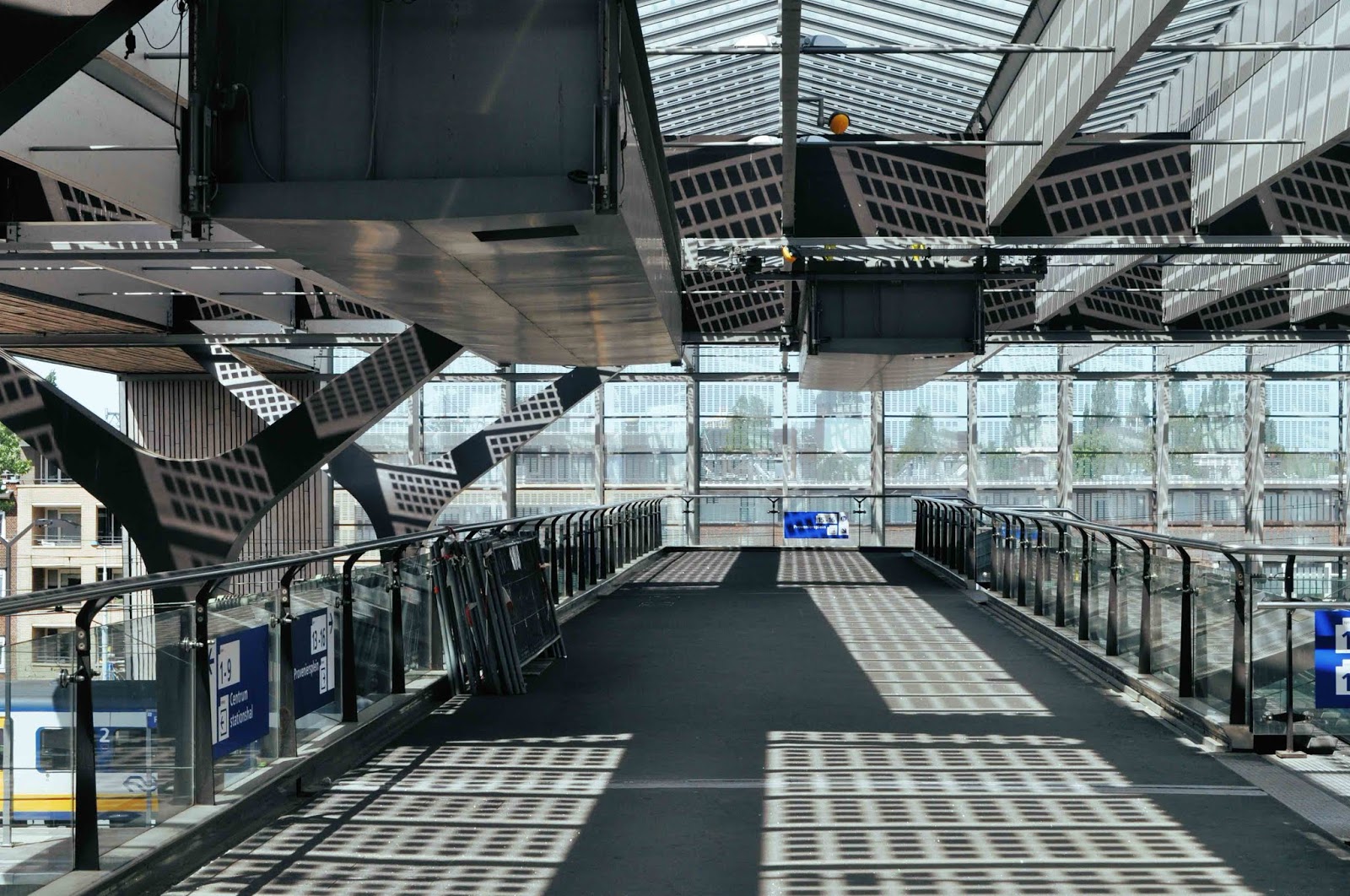
Great Railway Stations No. 15: Rotterdam Centraal


On 14th. May 1940 the centre of Rotterdam was destroyed by the Luftwaffe - 4 days had passed since the German invasion and patience was wearing thin in the German High Command who had expected to take total control of the Netherlands in 24 hours. In response to the fierce resistance mounted by the Dutch armed forces the first major airstrike of the war was ordered on Rotterdam as a message to the country that worse was to follow - the surrender took place the very next day. One of the casualties was the largest of the four railway stations that connected Rotterdam with the rest of the country - Delftsche Poort and in the post-war reconstruction train services were rationalised and combined into a single all-new station, Rotterdam Centraal. The new station which resembled the gently curving facade of a Modernist office block opened in 1957. By 2007 it was deemed inadequate and was demolished to be replaced by the present structure which opened in 2014.


The 1957 station (shown in the final image) was designed by Sybold van Ravensteyn, a long time specialist in railway architecture. Van Ravensteyn’s post-war career was overshadowed (but not curtailed) by his cooperation with the occupying forces, which included his design for a special carriage for the Reichskomissar for the Netherlands, the egregious Arthur Seyss-Inquart. Despite this his design was held in some affection by local citizens who campaigned for the retention of the station clock and the letters that spelled out the name of the station. Both were incorporated into the new expanded station.


A dramatically angular and asymmetric frontage makes for a bold and assertive landmark but elsewhere the new station is relatively understated. Designed for capacity and flow and not given to rhetorical vanities - the most striking visual effect is achieved by filtering sunlight through ridge-and-furrow roofing of alternating glazing and solar panels. It was built with an eye for detail. Y-form roof supports are echoed in the handrail clamps. The architects have spoken about the struggle they had with the brand managers at the state-owned railway (Nederlandse Spoorwagen) when it came to repositioning the letterforms from the old station. Their insistence that the name of the city must be included was eventually overcome by pointing out that anyone approaching the building would already be well aware they were in Rotterdam. Direct Eurostar trains to London were due to begin in March 2020 with the installation of security screening but are now postponed indefinitely. Since 2018 the Eurostar service to Amsterdam stopped at Rotterdam on the outward journey but passed straight through on the return.