Monday, 10 May 2021

Mid-century Romance and Misadventure

Bernard D’Andrea, Saturday Evening Post, November 1957.

Romantic fiction was a staple offer in the pages of Saturday Evening Post and a legion of highly proficient illustrators were on hand to give visual form to tragic and comic stories of love and betrayal. Some of the visual interpretations reveal a psychological complexity in a single image, every bit as effectively as a narrative spread over 8 or 10 pages of text.  These illustrators were masters of gesture and expression, expert in capturing minute variations in body language to convey emotional subtleties.  This was an age in which prosperity and anxiety seemed to advance in step - the Cold War undermined the sense of national security along with a growing unease that over-consumption and the breakdown in community values as millions moved to the suburbs was corroding the American soul.  The fear of crime couldn’t be washed away by alcohol and barbiturates.  Communism was an ever present, if ill-defined threat to the American way of life and efforts to eradicate its influence fed the climate of political paranoia.  Casual violence toward women and children was broadly condoned while adultery and coercive sex were only condemned if they came to public attention.  Maintaining an appearance of moral rectitude was imperative - any fall from grace would be ruthlessly punished by community pressure as much as legal proceedings. Women were often unwelcome and underpaid in the workplace and protection from harassment and exploitation was minimal. All these threads could be found in popular fiction and may explain why so many of these images contain unsettling and ambiguous gestures, glances and facial tensions. Carefree relationships and romantic bliss are in short supply.  Surrender to passion is more common, perhaps because it paves the way to the high drama of disillusion, treachery, desertion and cruelty.  This selection of images are mostly from Saturday Evening Post - artists are identified and dates of publication supplied where known.  Some examples are better than others. The subjects all include a couple - among them are several examples of what illustrators referred to as “the clinch” plus a few from other fiction genres such as crime and adventure.


Unknown illustrator, Saturday Evening Post.

Alex Ross in Ladies Home Journal, December 1948.


Saturday Evening Post, illustrator and date unknown.


Joe Bowler, Saturday Evening Post, date unknown.


An expedition to a lingerie store illustrated by Joe De Mers for Saturday Evening Post.


Jon Whitcomb for the readers of Ladies Home Journal, July 1948.


Coby Whitmore for Saturday Evening Post, date unknown.


Saturday Evening Post, date unknown.


A frantic couple under siege - illustrated by Bernard D’Andrea, Saturday Evening Post, "The Hounds Of Youth" (1961).


Thornton Utz illustration for Saturday Evening Post.


Saturday Evening Post, illustrated by Edwin Georgi (1896-1964).


Saturday Evening Post, illustrator and date unknown.


James Bingham, Saturday Evening Post, December 1955.


Alex Ross in Ladies Home Journal, October 1948. 


Saturday Evening Post, illustrator and date unknown.


Coby Whitmore for Saturday Evening Post, date unknown.


Peter Stevens (1920-2001) for Saturday Evening Post, September 29, 1956.


Steamy mid-century romance illustrated by Jon Whitcomb for Ladies Home Journal, September 1948.


Coby Whitmore for Saturday Evening Post, 1953.


Saturday Evening Post, illustrator and date unknown.


Lionel Gilbert (1912-2005) for Collier’s Magazine, January 1952. 


Saturday Evening Post, illustrator and date unknown.


Peter Stevens (1920-2001) for Saturday Evening Post, date unknown.


Saturday Evening Post, illustrator and date unknown.


Thursday, 29 April 2021

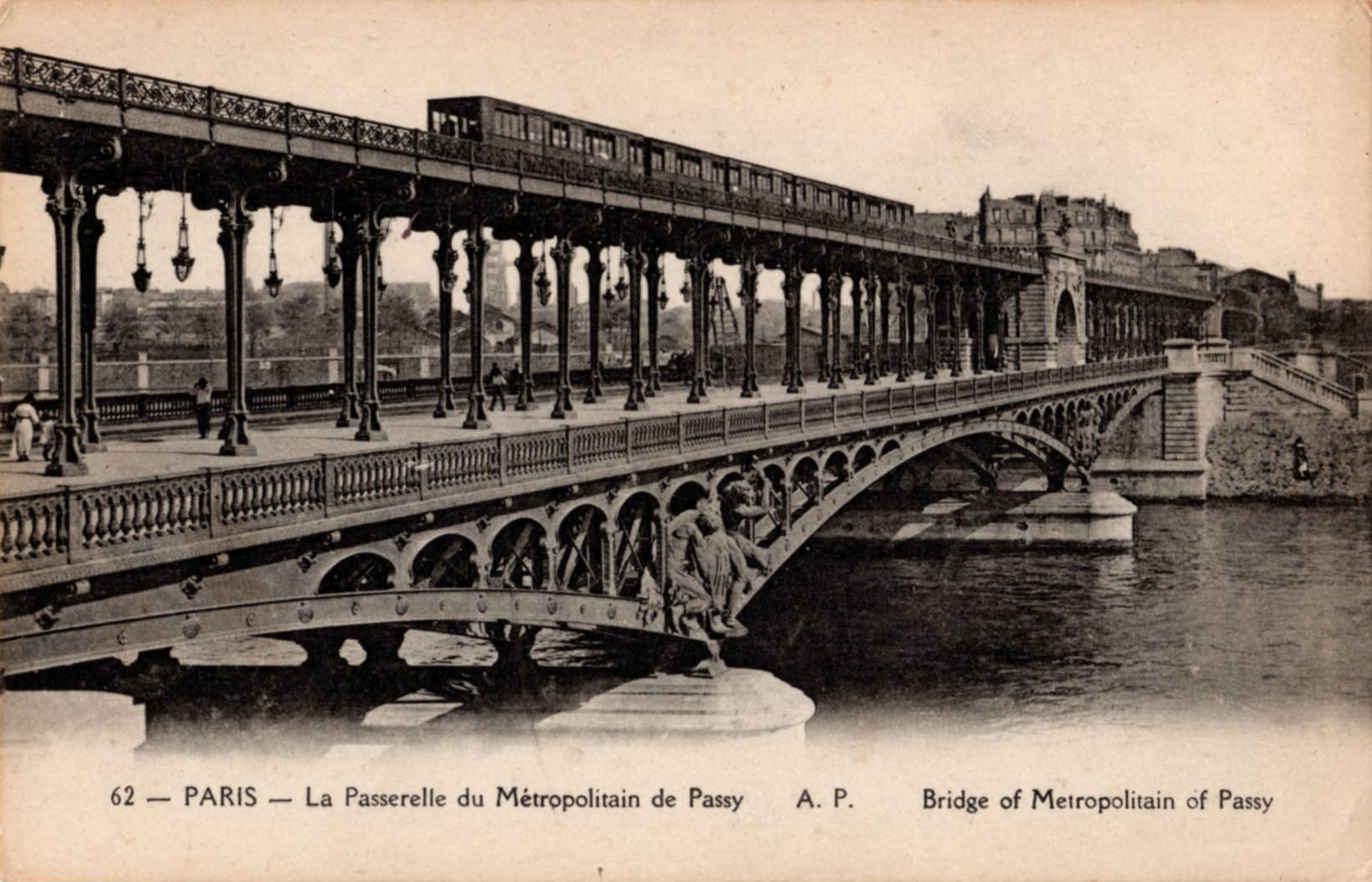
Bridges of Paris: 2 Pont de Bir-Hakeim

Pont de Bir-Hakeim links the Parisian districts of Passy (16th.) and Grenelle (15th.) and carries Métro line 6 over the Seine on one of two such crossings on its circuitous arc from Charles De Gaulle - Étoile in the west to Nation in the east. Approaching the Passy Métro station on rue de l’Alboni ends in a deep visual dive over the river Seine as if poised at the top of a ski slope.  From the railings at the end of the street the view takes in the platforms and canopies of Passy station and the ribbons of steel rail leading to the next station and beyond, deep into the 15th. arrondissement. Less obvious are the bridge abutments that mark the passage over the Seine which is the reason for this spectacular view opening up. 

The bridge itself is a two tier viaduct for road and rail (Métro) - in the centre of the roadway a pedestrian walkway and cycle route runs underneath the rail bridge.  The railway runs on a concrete deck supported by tall slender steel columns, each formed from four plate sections that taper and flare to make them easier on the eye. There’s more beautification in the form of Classical reliefs representing Electricity and Commerce on the stone built central arch. Additional sculptures grace the steel substructure where it rests on the stone pier of the Île aux Cygnes.  The bridge designer was Jean-Camille Formigé whose work can be seen all over the city on Métro infrastructure and the Viaduc d’Austerlitz. When the bridge was completed in 1905 it was known as the Viaduc de Passy – in 1948 it was renamed in honour of the Free French military victory at Bir-Hakeim in 1942.

The colonnade is a popular location for fashion photo-shoots and the bridge has made many appearances on screen, most notably in Zazie dans le Métro and Last Tango in Paris. The photos conclude with images of the elevated platforms at Métro Bir-Hakeim (formerly Quai de Grenelle).


Sunday, 18 April 2021

Postcard of the Day No. 103 Morlaix

A busy scene in the Breton market town of Morlaix where a narrow-gauge train operated by Chemins de Fer Armoricain, a metre-gauge network of lines built to connect small towns and neighbouring coastal settlements along the north coast of Finistère.  The Morlaix section opened in 1912 which may well be the year of the postcard. A group of women in Breton headdress are making their way into town, passing the modest but decoratively detailed station building, complete with édicule.  Above the train, the massive piers of a railway viaduct can be seen on its march across the steep sided valley in which the town is located.  What we see here is just the first level of the structure which has 9 arches - the upper level is more than 60 metres in height and has 14 arches.  Its presence is inescapable - it dominates the view from all districts of the town and must have been a hugely resented intrusion when it was under construction in 1861-63.  The lower level incorporated a pedestrian walkway but last time I was in Morlaix (more than 10 years ago) I discovered it locked and barred in a way that suggested it was unlikely to ever reopen.

After several years of construction the viaduct was fully opened in 1865 as a vital link in the main line from Paris to Brest operated by Chemins de Fer de l’Ouest. Today, up to 7 TGV services from Paris-Montparnasse cross overhead each day and the viaduct is protected as a national monument. These postcards are a reminder of how private commercial interests could transform a townscape that had evolved over many centuries by promising connectivity and future prosperity. At the same time public perception changes from outright hostility via gradual acceptance to popular veneration as a monument to engineering achievement.  The narrow-gauge railway was barely viable from the start and never generated enough traffic to pay its way - the convenience of delivering passengers to the heart of the town was offset by the lack of potential business in the sparsely populated hinterland. It closed for good in 1934 after only 22 years of service. Despite several visits to Morlaix over the years, I had no idea of its existence until I saw this postcard.


Wednesday, 14 April 2021

Down the Mississippi in Monochrome

Recent lockdown rooting through old negatives and digitising turned out to be a lot less rewarding than I hoped. Resulting scans were often hazy, unfocused, poorly exposed and tonally flat.  The passage of time has stubbornly failed to confer much in the way of retrospective luminosity. This group of photographs are from a $7 boat trip from Canal Street, New Orleans along the Mississippi river, the Algiers Canal and the Harvey Canal. It was a heavily overcast and humid day - the photos correspondingly low-key and devoid of shadow. It’s striking to see so much decay and dereliction - even the ships are drowning carcasses with flaking paint streaked with oxidisation.  Surprisingly some of them are from the Soviet Union and Iran. Waterside warehouses crumble into the river while fishing boats moulder at their moorings. The most viable economic activity appeared to be servicing the oil rigs in the Gulf of Mexico.  This was 1978 - by some measures the high point of the post-war era of universally rising incomes, taxation funded benefits and social care and a shrinking gap between income extremes. Jimmy Carter was in the White House but Ronald Reagan was on stand-by to roll out the great neocon pushback.  Major US cities were sliding into bankruptcy, the drug culture had crossed over into the mainstream and a sense of profound exhaustion seemed to have set in. The stage was set on which Reagan would declare “Morning in America.”

Part of the itinerary was a visit to the Rene Beauregard House at Chalmette, owned and cared for by the National Park Service.  The ante-bellum mansion overlooks the site of the Battle of New Orleans of 1815 in which a smaller, nimbler American force trounced a much larger, belligerent but incompetent British invading force.  Americans have every reason to celebrate this engagement while the British, who swaggered into battle with every expectation of an easy victory were taught a lesson that to this day appears less than fully learned.  A team of Southern Belles in period costume were on hand to explain - they were silent on explaining how the prosperity of the plantation depended on the labour of slaves.

Revisiting these photographs involves a little, lightweight soul-searching.  The question is whether the air of decay was a result of selection on my part, overlooking anything that didn’t fit with my preconceptions. This is where I suspect the influence of David Plowden whose gritty, beautifully composed  photos of the depredations of the industrial landscape in America I much admired.  Instead of looking through my own eyes, I was looking through what I thought were the eyes of Plowden.  All this speculation leads to an uncomfortable place where there needs to be a reckoning with the way that over familiarity with the work of eminent photographers can easily generate a culture of imitation - something I’m all too aware of when I take a hard look at my own efforts. Looking from another angle, perhaps expectations are just too high and the pursuit of authenticity and originality is best left to those with greater ability.  Thanks to the mobile phone there have never been so many photographers on the planet as there are now. As their efforts multiply in the cloud in their millions and billions of images I get no sense of widespread agonising over issues of authenticity and it’s only to be expected that some (or many) of these photos will quite transcend our own in boldness of conception.


Thursday, 8 April 2021

Paper - Material of a Thousand Uses

This guide to the uses of paper is a typical mid-century publication aimed at schools, offering free learning materials in return for a chance to advance the cause of business to a new generation.  For a modest financial outlay, businesses could present a human face and claim to be agents of corporate responsibility.  The illustrations will be immediately recognisable to anyone familiar with the artwork in Ladybird Books - formal, descriptive, slightly heightened in colour and unemotional.  Two themes dominate, the first being to impress the young reader with a sense of the mammoth scale of the enterprise - vast machines operated by a workforce of heroes. The second theme is best described as a thousand things you never knew about paper from tabloids to tissues. It shows us an orderly society where the working man wore a flat cap and foremen wore brown coats - a lost world of stoic deference selectively recalled by an older generation desperate to see it revived before they exit the stage.