Thursday, 22 June 2023

Postcard of the Day No. 112, Starcross

Captain George Peacock was born in 1805 into a naval family in Exmouth. He served in the Royal Navy and the Merchant Navy as well as pursuing a career as a surveyor and inventor.  In 1831-32 when sailing in the Royal Navy in South America he surveyed some potential  routes for a future Panama Canal.  The value of his pioneering work was recognised by de Lesseps 50 years later when the canal was finally constructed.  Four years later he surveyed the Corinth Isthmus and proposed a route for a canal, for which he was, many decades later, honoured by the Greek sovereign. By 1840 he was sailing with the Pacific Steam Navigation Company in South America for whose benefit he set about developing business opportunities. In Chile he established the first coal mine in the continent, after which he explored nitrates in Chile and located guano deposits in Peru.  In 1841 he supervised the construction of the first railway on the west coast of South America. Inventions were many and various, including an improved screw propellor for steamships, a desalination treatment for sea water on board ship, an early form of life jacket and anti-fouling paint for the protection of iron hulled ships.


Not content with all this, after retirement to Starcross on the Exe Estuary he designed and built the Swan of the Exe in the 1860s, a 10 berth sailing yacht in the form of a swan, equipped with two large wings that served as sails. Internal fixtures and fittings were said to be comparable with those in a First Class railway carriage. Four small swan-shaped launches were built, one of which, known as Cygnet was employed to ferry passengers from the shore to the yacht and can be seen in these postcards.  This eccentric vessel became a celebrity in the Exe Estuary and was written up in the press.  By the time these postcards were on sale the Peacock Swan was over 50 years old and in the care of his descendants.  There’s a mass of conflicting information about its ultimate fate, some witnesses claim to have seen it afloat in the 1930s after which it seems to have become unseaworthy and downgraded to the status of garden ornament. Cygnet did survive and is now on display at the Museum of Topsham on the opposite bank of the Exe.  Artist and designer Enid Marx (1902-98) made a colour linocut of the Starcross swans in 1936 that can be seen by following this link.

Friday, 9 June 2023

In a Dorset Hollow Way (Part Two)

The soft sandstone sides of the Shutes Lane Hollow Way have become a home for rural graffiti, much of which follows familiar formulae but the exceptions are intriguing.  Interestingly there’s virtually no sex or politics to be seen.  Names and initials are present in great numbers as are images of eyes (evil and all-seeing) and hearts, most of which are simple incisions. Many have been scratched in haste while some display an interest in more finished letter forms with serifs and downstrokes.  A few have taken the time to record aphorisms and more enigmatic text elements.  The images of human heads fall broadly into three categories - simple incisions, basic formal modelling and complex modelling with spatial recession.  Examples of non-human heads are usually non-specific while reflecting the visual clichés of the horror genre.  I have been told I missed the single example of an unambiguously female head but many are gender non-specific.  Homer Simpson makes two appearances alongside Stewie from Family Guy but nobody else can easily be recognised.  More than a few share the characteristics of Outsider Art and communicate a genuine sense of human despair with conviction on a sliding scale from expressions of mild despondency to an existential scream of desperation drawn from the inorganic depths.  There are expressionless eyes that appear to stare back at us as if they’ve been witnesses to unimaginable terrors and mouths that exhale the odour of brimstone. Then there are those that promise more than they can deliver - hours of hard labour carving out an emblem of terror and ending up with something faintly comic.  Happiest of all are the unambitious mark makers whose scratchy efforts have a light charm. Finally - a salute to the five-legged elephant.


Tuesday, 6 June 2023

In a Dorset Hollow Way (Part One)

The existence of Hollow Ways (aka Sunken Lanes) has long been a source of fascination to scholars of the countryside.  Ancient trackways where centuries of human and livestock traffic together with floodwaters and natural erosion have embedded their presence deep in the rural topography.  Exposed tree roots and ferns cling to the steep sides of the pathway as it passes through an arboreal overhead canopy that filters the sunlight.  They form most readily in areas where the underlying geology is least resistant such as chalk downland or greensand. The county of Dorset has many examples, of which one of the best known is Shutes Lane on the Symondsbury Estate to the west of Bridport.

The cumulative effect of atmospheric stillness, dappled, contrasting light effects, luxuriant vegetation, a sense of enclosure and the visual drama of the craggy exposed and weathered geology is enough to stir the spirit of the most materialist explorer.  For those of a more Romantic disposition it can be a starting point for all manner of fantastical imaginings and mysterious speculations - the presence of faeries, piskeys and elvish folk can be felt, forever just outside the field of visibility.  An alert student of landscape formation will be intrigued by the tactile record of the passage of time measured in centuries - a record more easily read and understood than elsewhere.  With the relentless expansion of agri-business and agri-chemicals leading to depleted natural habitats and the irretrievable loss of species diversity, exacerbated by extreme weather events, a new sense of urgency has typified recent literature on the countryside and unsurprisingly writers have turned their attention to the survival of England’s Hollow Ways as places largely untouched by the mixed blessings of scientific advancement.

Walking the mudslides of Shutes Lane in winter can be heavy going but a month without rain has baked the surface of the path to the point that passing feet are grinding it into dust.  The sheer scale of it is impressive, massively exceeding others I’ve seen in Somerset and Devon, giving it the appearance of a chasm or canyon. We had the company of three grandchildren under 6 and they walked more than 4 miles without a mutiny.  What held their attention was the multiple hand carvings made in the soft sandstone of surpassing eccentricity which will be the subject of Part Two of this post.


Tuesday, 16 May 2023

East Tilbury, the Bata Legacy in Essex

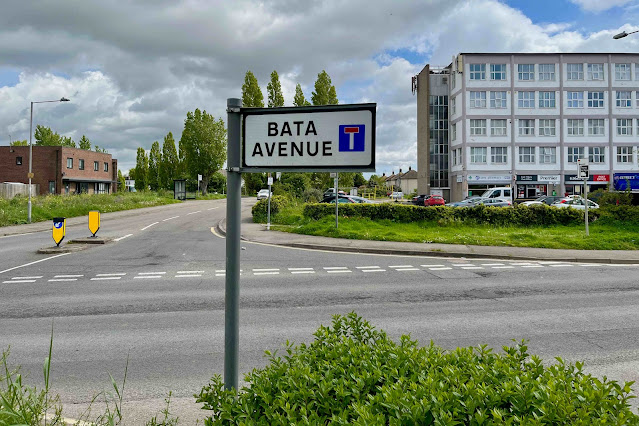
A trip to Essex is a rare event so we took the opportunity to take a c2c (owned by Trenitalia) train from Barking to East Tilbury where Bata shoemakers established factories and an industrial village in the 1930s. Public awareness of Modernism in 1930s England was minimal and in the Essex village of East Tilbury even less.  It must have been a shock to the villagers when Modernism landed on their doorsteps in 1932 as they watched towers of welded steel and reinforced concrete rising out of the potato fields of the former marshland.  This marked another stage in the global advance of the Bata Shoe Company founded by Tomas Bata in 1894 in the town of Zlin, Czechoslovakia.  A visit to the Ford factory in Detroit had inspired Bata to adapt the latest production line technology to the manufacture of footwear and the company had expanded rapidly across Europe and beyond.  Bata was attracted to the social ideals and paternalism of the Garden City movement but his aesthetic preference was for Modernism rather than Arts and Crafts or Tudor revivalism.  

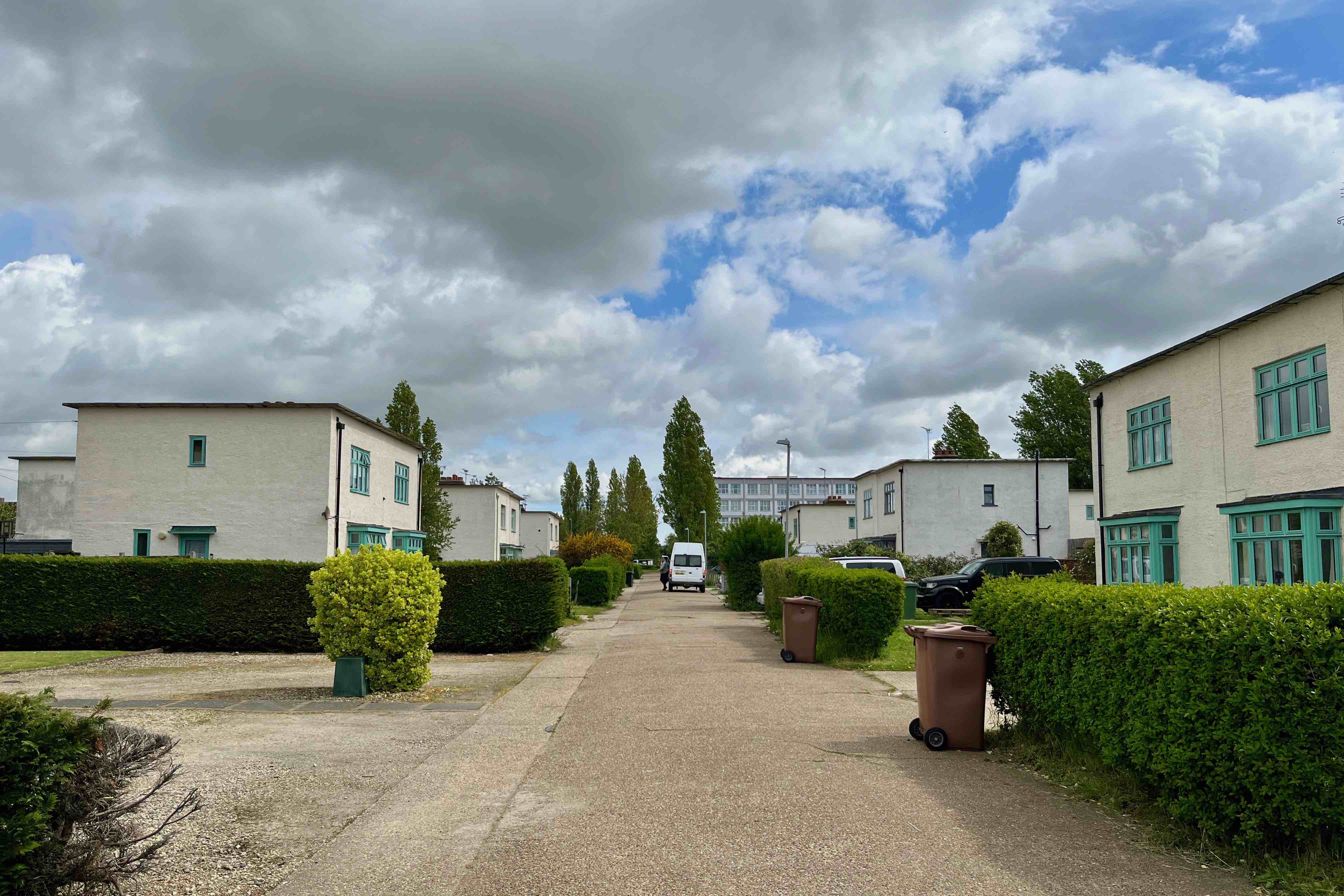
Czechoslovakia was much more receptive to Modernism than Britain and a company team of Czech architects led the project. Planning and design principles that had been established in Zlin were applied in East Tilbury and included material specifications and the use of reinforced concrete frames. As originally planned there would have been 3 ten-storey factory blocks plus a rail connection to what was then part of the LMS railway with sidings for loading and unloading. These were scaled down to five-storey blocks and the rail connection never materialised. When the factory opened in 1933 in the Depression, locals welcomed the employment prospects although their eyes must have been startled by the Modernist geometry and the acreage of glazing in the brand new, multi-storey factory buildings.  New housing for workers (a significant number of whom were Czech) and their families along with a clinic, sports ground and village hall were provided and despite the challenge of inducing the English to live under flat roofs, this concern for their welfare was fondly remembered by former employees.  Manufacturing in East Tilbury petered out in 2006 by which time the factory buildings had already been disposed of to an uncertain future. The Bata Company is still in business and based in Switzerland. Its products are sold in many countries from East Asia to Latin America, Europe, Africa to Australia but UK is not one of them. 

At the peak in the 1950s there were 3000 employees at East Tilbury and over 200 Bata shops on Britain’s high streets but the business was not immune to Britain’s industrial decline and in the 1960s production began moving overseas, mainly to developing countries. The design influence of the Czech parent had gradually faded away and the worker housing  became entirely conventional - semi-detached with pitched roofs. The last company housing was completed in 1966 and in the 1980s the houses were sold off to private buyers in the spirit of the time.  The process of adjustment has been difficult.  Converting the major buildings for new uses has been expensive and attracting investment has been hard but most of the factory premises have found new tenants over the years and the only major building still in need of renovation is Nelson House (the former leather factory) on top of which sits a water tank, lettered on all four sides with the Bata logo, easily visible to railway passengers almost a mile away.

In 1939 Bata completed a new 16-storey HQ in its Czech hometown of Zlin that included a top floor office for the Chief Executive, Jan Bata, designed as a giant lift capable of descending to ground level at the stately pace of 75 cm per minute. The Nazi annexation of the Sudetenland in 1938 and occupation of Czechoslovakia stopped the project in its tracks and despite Jan Bata’s personal appeals to the Nazi overlords, the factory was closed.  The Bata diaspora gathered pace and new businesses were opened in the US and Canada and production expanded in India and Singapore.  When Bata refocused  on emerging economies it withdrew from most European operations leaving an architectural legacy of design excellence that became a serious problem for planners in Bataville in France and Batadorp in the Netherlands (as well as in East Tilbury) as they grappled with the challenge of adapting the buildings without compromising the features that made them worthy of preservation. There are two further sources of detailed commentary on Bata, the first is a Historic Area Appraisal of East Tilbury carried out for English Heritage in 2007 and the second is a wider historic survey of Bata’s global presence from the magazine Azure.


Thursday, 11 May 2023

Bruce McCall (1935-2023)

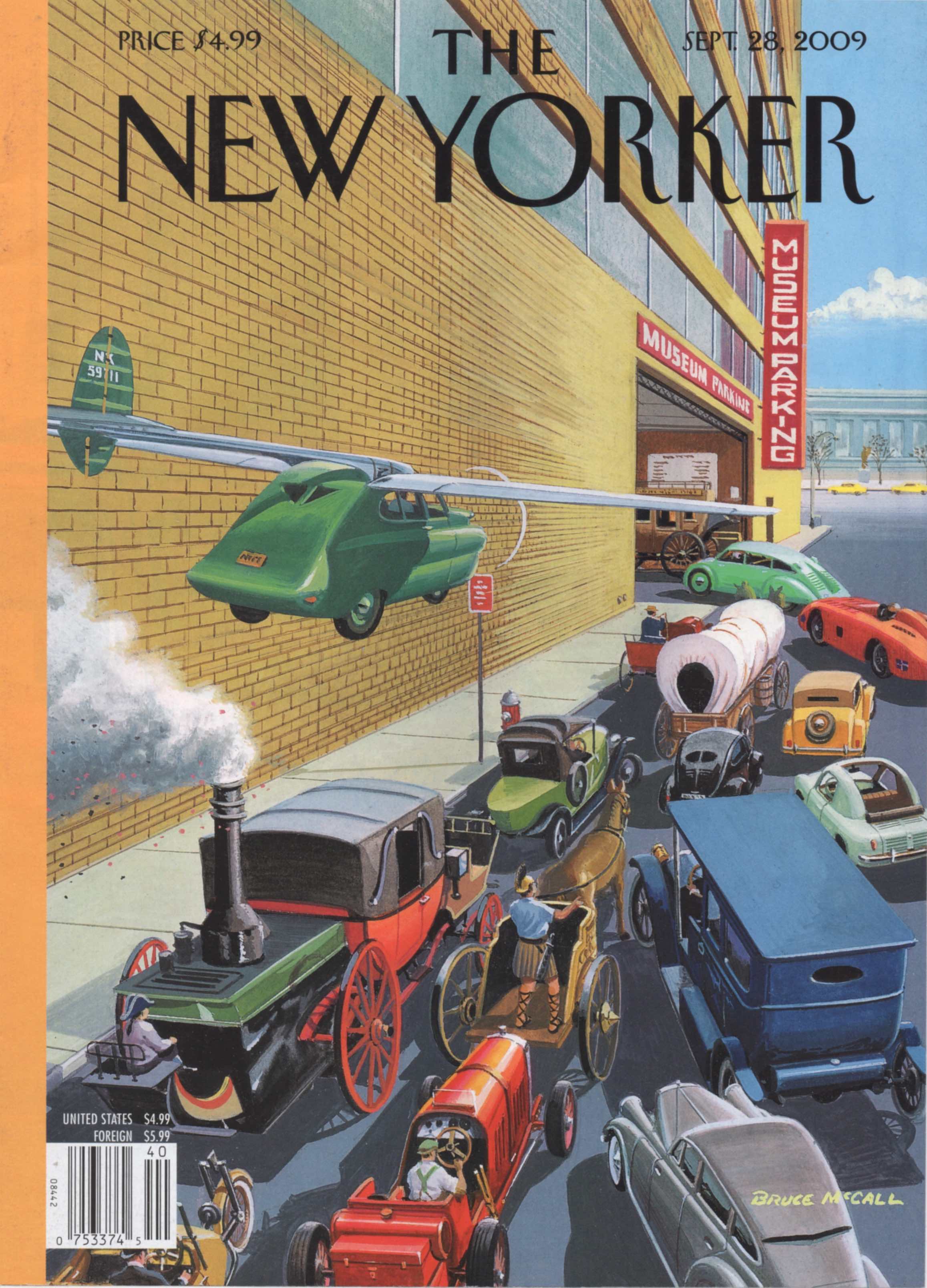
I’ve been a fan of Bruce McCall’s illustrations since I first saw his parodies of Streamline Moderne in the pages of National Lampoon (see above). When he became a regular cover artist at the New Yorker I collected his covers as well as his books (Zany Afternoons, All Meat Looks Like South America).  In the past I’ve read some snide criticism of his work - stylistically conservative, unadventurous and boring, but that ignores the ingenuity and asperity with which he undermined the conceits and social pretensions of self-conscious modernity. His experiments with the visually incongruous could rival those of Magritte, an artist whose work was greatly enhanced by conservative techniques of representation. By the time of his death he had drawn 83 New Yorker covers (almost 18 months worth) and though he kept returning to the same themes (human vanity, bears, ocean liners, aviation, motor vehicles, advertising) he always found something fresh to say in his familiar deadpan fashion. With decades of experience toiling in the advertising industry he knew whereof he spake. He died last Friday at the age of 87, by way of tribute this is a selection of my favourites of his streetscene covers for the New Yorker taken from my scrapbooks.


 Plus two examples kindly provided by Robin Benson.