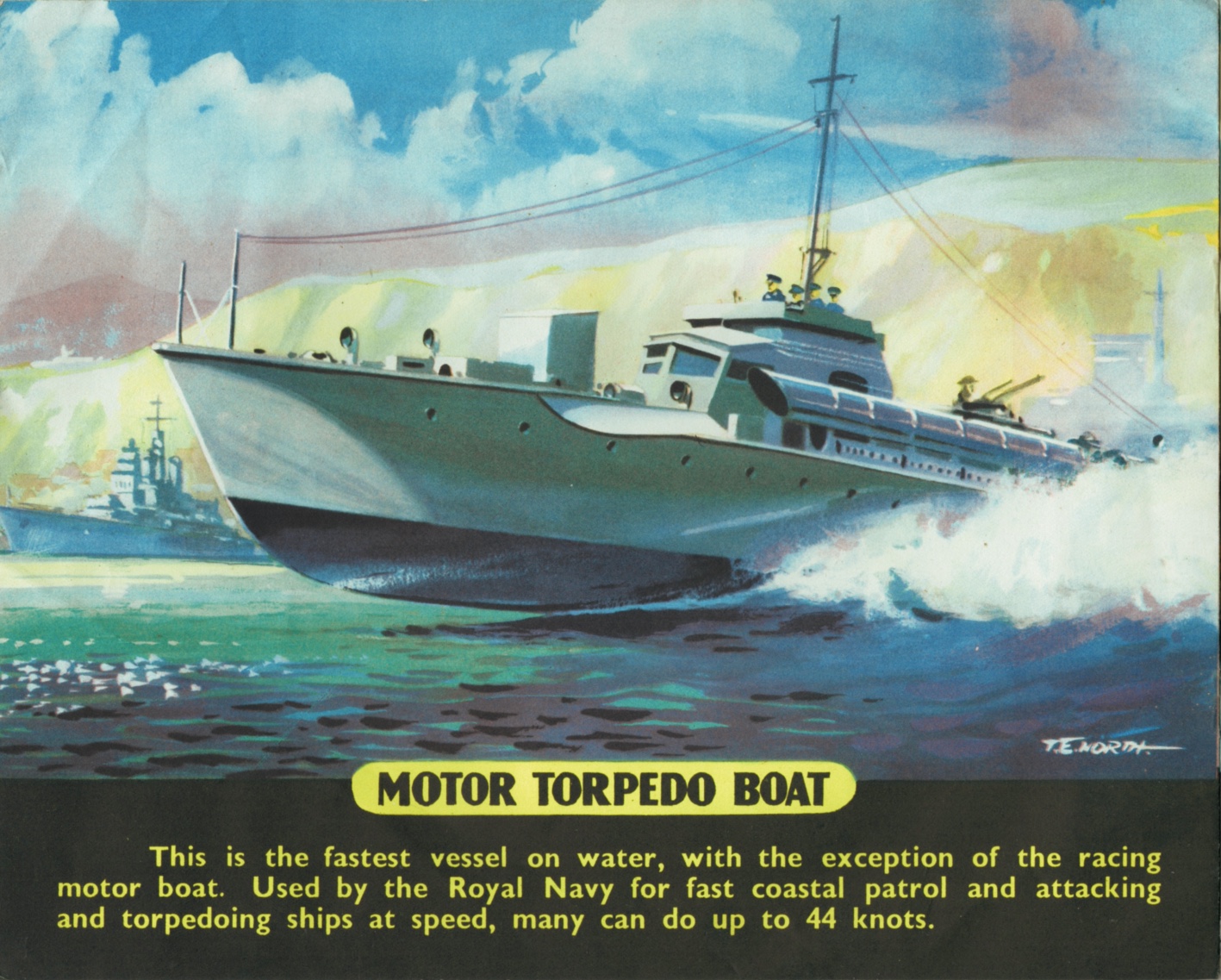
The book illustrations of T E North were featured here a few months ago when we posted about an aviation picture book (Airways) published in 1939. Notable for compositional originality and precision drawing, the qualities displayed in Airways faded in his post-war output in line with contemporary trends. After 6 years of war during which he served in the RAF, rebuilding his career and adapting to a much changed commercial situation would have been difficult. The services of an assiduous agent would have been essential and it may have been an agent who spotted his affinity for transport subjects and marketed his skills to publishers. Appropriately for an artist born and bred in Hull this example is a book of maritime illustrations for young people. Atmospheric effects predominate, brought to life by more gestural brushwork and a dramatically intensified colour palette. Perhaps the romance of the age of the great ocean liners and the cargo ship demanded a more vigorous approach. Recent collective memory of war fought at sea and the prestige invested in building ever larger and more luxurious liners fixed all things maritime firmly in the mid-century popular imagination in a way that’s inconceivable today. The image of the ship’s captain was a figure of steely resolve, commanding the loyalty of the crew in the face of danger from the elemental terrors of hostile seas. Young readers could be enthralled by the exotic network of international shipping, at the centre of which they were assured, Britain stood supreme and unchallenged - a supremacy that evaporated at breathtaking speed over the next decade as the nation first decolonised and later de-industrialised.
Wednesday, 22 November 2023
Tuesday, 14 November 2023
Motoring Celebrities
Glaswegian tea tycoon, Sir Thomas Lipton would have been in his fifties when the camera captured him here - he worked hard to cut a dashing figure in public, active in the sports of yachting and sailing. In his youth he spent several years in the US and the commercial spirit he absorbed enabled him to amass a great fortune in the grocery and tea trades. Investment in publicity was the key to his success. The Lipton business has been featured here in 2007 and 2020.
The first 14 years of the 20th. century were golden times for both the motor car and the picture postcard. While the motor car was the province of the rich, the postcard was cheap enough to be affordable to almost everyone. An embryonic consumer society expanded across the nation until the outbreak of war in 1914. When peace returned in 1918 the postcard went into steady decline but motoring would go on to dominate the next hundred years as the favoured means of transport. Celebrity culture was in its infancy, mostly populated by military heroes, cricketers, footballers and stars of the music hall and theatre. Inevitably they came together on the postcard and celebrities self importantly posed at the wheel of an automobile made a popular subject.
The Dare sisters (Zena and Phyllis, born in Chelsea and daughters of a divorce clerk) were truly Made in SW3 Edwardian celebrities and though long forgotten today their maidenly faces peered coyly out of many a picture postcard in their day. More than 1,500 examples of Zena alone are listed on eBay at the time of writing. The two sisters were 12 and 9 respectively when they made their stage debuts in a Christmas pantomime in December 1899. Under the guidance of the ultra-successful actor-manager, playwright, producer and impresario, Seymour Hicks, they would grace the London stage in a succession of dramas, comedies and musicals for decades.
Sybil Arundale was a child performer in the music hall and graduated to Shakespeare and Ibsen parts in the theatre. Cinema and TV followed - she died in 1965. Gaynor Rowlands’s career as a dancer was curtailed at the age of 23 when she died in 1906 during an operation for appendicitis.
Constance Collier made the transition from the London stage to Hollywood where she found work in silent movies and went on to become a leading voice coach in the late twenties with the advent of the talkies. In 1948 she was cast in Hitchcock’s Rope as Mrs. Atwater and her star shines on the Hollywood Walk of Fame. Her companion, Lettice Fairfax was a stage actress specialising in musical comedy - her career seemed to stall in 1925 and she died in 1948.
Sunday, 5 November 2023
Postcard of the Day No. 113, Sutton Bridge
It seems the arrival of the camera was anticipated since the signalman has brought his daughters along to be part of the photograph. Father is stood behind them as they pose on the balcony. Another railway employee stands in the doorway to the signal box, sporting a watch and chain. In the distance the operator of the swing bridge has stepped out of the control cabin to be included in the picture. All is unusually pristine and crisp - from the timber fencing to the signal gantries via the rivets on the bridge. The track work and the signal cabling is in immaculate condition.
This is the Cross Keys Swing Bridge, an east-west crossing of the River Nene at the Lincolnshire town of Sutton Bridge as photographed from the station. When it opened in 1897, one span served as a roadway while the other was used for railway traffic by the Midland and Great Northern Railway connecting East Anglia with the Midlands and Northern England, mainly for the transport of coal and it remained that way until the railway closed in 1965. The spans are only wide enough for one-way operation and two signal boxes were required to safely filter the rail traffic into a single track. Power supply for moving the bridge was initially provided by two adapted locomotive boilers installed by Armstrong, Whitworth. In latter years electric motors did the job. Commercial shipping bound for Wisbech and leisure craft still pass and the bridge remains in occasional use. Both the bridge and the Engine House (not visible in the postcard) are Grade II* listed by Historic England.
![]() |
| Heywood Sumner |
Friday, 27 October 2023
Paintings from Penlee House Museum, Penzance
We begin with a flatly painted image of a pint of beer in a straight glass resting on an otherwise empty table in the grip of a sturdy hand - it’s a factual exercise and nothing more. Attached to the hand is Robert Morson Hughes, a fellow artist and associate of the painter Harold Knight - the year is 1915, the First World War is in progress and Knight, a conscientious objector, is about to be put to work as a farm labourer. The subject, Hughes, was a Lamorna based painter of mainly topographical subjects. Here he has the air of a country landowner in a slightly oversized suit, from beneath the downturned brim of his hat he stares with suspicion out of the painting. Knight has conveyed strength of character and a sense of presence in a stolid, unemphatic manner.
Harold Knight (1873-1953), Portrait of Robert Morson Hughes (c 1915)
![]() |
Robert Morson Hughes (1873-1953), Carn Boscawen (1928?)
Visits to local museums are always a pleasure and Penlee House Museum is a fine example that has the dual function of providing a lively overview of local history with a comprehensive collection of interesting paintings by locally based artists with historically national reputations. The core of the collection is made up of painters active in the 19th. and early 20th. century, working in the Penzance - Newlyn region of Cornwall. Aesthetically conservative, averse to experimentation and inheritors of a tradition of realism that goes back to Courbet (as diluted by Bastien-Lepage), these painters built up an impressive visual archive of the minutiae of Victorian and Edwardian daily life in West Cornwall alongside a comprehensive record of the abundant varied landscape and coastal scenery in the county. Many had worked in the art colonies of Brittany and become committed to painting en plein-air but Impressionism remained a step too far.
![]() |
Laura Knight (1877-1970), My Lady of the Rocks ND |
Although this body of work has come to be regarded as an essential component of the Cornish cultural identity it’s notable that many aspects of that identity were, for the most part, studiously ignored. While the fishing industry was much celebrated for its pictorial values, the world of mining, heavy engineering and new technologies got little or no attention - the only exceptions being quarrying, a reliably popular landscape subject and the railways that became a regular source of income for Stanhope Forbes. All this despite Cornwall having a strong claim to being the global birthplace of steam power. The Celtic heritage that separated Cornwall from the Anglo-Saxon territory east of the Tamar likewise went unremarked along with the great Neolithic assemblages of menhirs and stone circles, at least until the 1940s when Ithell Colquhoun turned up in Lamorna. Most of these painters were drawn to Cornwall from elsewhere in the country and many formed strong personal links with the indigenous community, their interests didn’t encompass the profound sense of Cornish exceptionalism held by the local intelligentsia.
![]() |
Stanhope Forbes (1857-1947), Abbey Slip (1921) |
![]() |
Laura Knight (1877-1970), Spring (1916) |
This is not to undervalue the contribution that these artists have made to the popular image of Cornwall as a special place. Their brushes may have been preoccupied with surface values but by virtue of sheer representational brilliance their work acquired lasting value. Laura Knight and Stanhope Forbes stand apart in the quality and consistency of their work though Knight’s paintings have a bravura and vitality that often make Forbes look pedestrian by comparison. By the time Laura and Harold Knight moved to Newlyn in 1907, Forbes was well established as the leader of the Newlyn painters where he’d been active since 1884. The Knights settled in Lamorna but were soon accepted into Forbes’s circle. While Harold’s taciturn nature caused him to hold back, Laura played a full and active part in the social life of the artistic community. For his part, Forbes was especially impressed by Laura’s paintings. Most Newlyn painters stayed loyal to their locality a few shuttled back and forth to St. Ives where new ideas were more readily accepted. Forbes reacted with disproportionate hostility when Whistler and Sickert spent time in St. Ives. This went both ways - Sickert especially loathed the paintings of Newlyn’s Frank Bramley whose A Hopeless Dawn was rapturously received by an audience hungry for pathos at the Royal Academy (RA) in 1888.
![]() |
Norman Garstin (1847-1926), The Rain it Raineth Every Day (1889) |
Most of the Newlyners were reluctant to stray far from their patch - an exception was Irish born Norman Garstin whose global wanderings set him apart. His travels took him to Africa, North America and all over Europe and inspired him to lead groups of students on sketching trips to continental art centres. In 1889 his major painting of a rainswept Penzance seafront (The Rain It Raineth Every Day), was rejected by the RA for being ‘too French’ with its subtle tonal observations. Further humiliation lay in wait - when Garstin later presented the painting to Penzance Town Council it was hidden away for fear it would deter visitors. Garstin’s vindication may have been a long time coming but today’s visitors have voted it their favourite painting in the museum. A future post will look at how local history is served in the museum
![]() |
Samuel ‘Lamorna’ Birch (1869-1955), The Quiet of our Valley (1940) |
![]() |
Samuel ‘Lamorna’ Birch (1869-1955), trio of landscapes, Lamorna Valley in Summer (right) |
![]() |
Frank Gascoigne Heath (1873-1938), A Game of Cut-throat Euchre (1909) |
![]() |
Frank Gascoigne Heath (1873-1938), The Little Maid (1923) |
![]() |
Charles Simpson (1885-1971), Dying Light, Carn Barges ND |
![]() |
Stanley Gardiner (1888-1952), The Old Quay, Lamorna (Upper), Samuel ‘Lamorna’ Birch (1869-1955), Lamorna Cove (Lower) |
![]() |
Harold Harvey (1874-1941), Laura and Paul Jewill Hill (1915) |
![]() |
Frank Bramley (1857-1915), Eyes and No Eyes (1887) |
Wednesday, 18 October 2023
Rundfahrten
The tour bus never goes away - every major city has fleets of these vehicles, usually open-topped, finished in garish colour combinations and accompanied by teams of outriders roaming the streets to sign up new customers. It’s sightseeing at its most basic, sit back and let the sights come to you. Seconds later your photos can be glowing on Instagram. In the interwar years the tradition was for a jobbing photographer to capture the tour bus and its passengers before its departure. Darkroom technicians would swiftly do their magic and sparkling prints would be sold to passengers on their return. The results were often surprisingly good considering the time pressure and as you might expect, these examples from German cities achieved a remarkable degree of definition.
We begin with the Berlin tour guide posed in front of the bus on the Unter Den Linden - like everyone else she squints into the glare of low autumnal sun. Hats, overcoats and furs offer protection from the cold, the date is October 6th. 1922. Most passengers make the effort to smile for the camera and have the air of belonging in upper income groups. A potential subversive loiters second from the right, his prominent facial hair indicative of a non-conformist nature. Moving on to Cologne in 1910 we meet a horse drawn charabanc outside the west doors of the cathedral. Uniformed staff in top hats are in charge and the group are perched high on upholstered benches. Not so many smiles in 1910 and some notably grumpy veiled faces. Three further examples from Cologne, all posed outside the cathedral and examples from Munich and Nuremberg complete the selection.