Wednesday, 29 March 2023

Cargo Handling 1932

A set of 1932 collector cards from Liebig, a portfolio of dockside views showing the loading and unloading of cargo ships.  Motor vehicles and locomotives are craned through the air along with minerals, while grain is loaded on board via a system of tubes and pipes.  These scenes have largely disappeared from today’s ports where the shipping container reigns supreme.  Very few items can’t be compressed or disassembled into a container. It was a spectacle that would have appealed to the technically minded child of the time growing up in the era of the Meccano Magazine (which itself featured many such illustrations on its covers).  The style of illustration has evolved with the times - gone is the precision and finesse that graced the cards of earlier decades to be replaced by more simplified drawing with heavier contours and a heightened colour palette.


Saturday, 25 March 2023

Lands End, Kernow’s Last Gasp

Visitors from over the border in Tiverton pose for the camera at Lands End.  Dated on the reverse - July 1st. 1960.  Probably born in the last decade of the 19th. century, they are of the generation that survived two world wars and came well experienced in the hard graft of stoicism. Defined by the formality of their dress - suits or blazers, collar and tie and well polished shoes for the men. The men could be brothers and their wives could be sisters.  The Lands End estate has always been in private hands. An attempt by the National Trust to purchase it in 1987 failed when Peter de Savary outbid the organisation.  Today’s site owner is Heritage Great Britain Plc who operate a minor empire of mid-level attractions including a petting zoo, an audio-visual experience, traditional craft studios, a shopping centre, the First and Last public house and a hotel and restaurant complex.  Plus a car park from which the coastal footpaths can be reached.  It’s easy to imagine the more environmentally sensitive development that the National Trust would have provided but it has to be conceded that it would have been every bit as commercially minded in extracting value as the present owners.

The version of Cornwall with the greatest cultural heft is the magical land of myth and legend where the landscape itself vibrates with mystical powers under the protection of St. Piran. From Jethro to Ithell Colquhoun, locals speak of the sense of relief and heightened sensory impressions when the wretched land of the lumpen Devonians is left behind as they cross the Tamar into the enchanted homeland.  My youngest son and I experienced something of this in the summer of 2002 as our train from Exeter inched its way through Saltash station at less than walking pace. A small group of wayward urchins, no more than 11 or 12 years of age, was inspired to offer a traditional Cornish welcome to its captive audience. Jumping to attention from the abandoned luggage trolleys on which they had been reclining they conjured up imaginary erections of stupendous proportions via the medium of gesture and mime which they directed at the gawping passengers.  With well rehearsed movements of the hand in which enthusiasm triumphed over subtlety they brought their imaginary organs to a towering climax as the holidaymakers were ever so slowly conveyed in silence closer to the beach and surf.  It was a rare moment when the affluent seasonal visitors came face to face with the boredom and resentment of the indigenous population.  During the journey a young female passenger had been passing to and fro through the carriage clad in a T-shirt bearing the slogan, “Stop staring at my fucking tits” suggesting that if the urchins had been bold enough to board the train they might not have wanted for like-minded company.  Not the warmest of welcomes to the sacred county of Kernow.

Every MP in Cornwall is a Conservative.  It’s worth recalling that when the Cornish complain, as they do, that they’re overlooked, ignored and left behind by Westminster.  Spokesmen for the fishing community in Newlyn can outperform their counterparts in Peterhead and Brixham when it comes to complaining.  Since their former colleagues sold off their fishing quotas to European competitors they’ve never stopped wingeing about how hard done by they are.  Cornwall is certainly a complicated county with a powerful sense of identity that can shade into exceptionalism, equal to anything found in Yorkshire.  Celtic roots are carefully cultivated by Mebyon Kernow (Cornish Nationalists and campaigners for a Cornish Parliament), Cornish bards and Cornish language revivalists.  An abundance of megaliths, menhirs, cromlechs and stone circles encourages a spiritual sense of place for some, though there would be many more standing stones if Cornish landowners had refrained from destroying them when they got in the way of the plough. While many in Cornwall find a virtuous path into the spirit world, the dark shadow of Aleister Crowley and his “Scarlet Women” still lingers over West Penwith. The landscape value is exceptionally high and includes wild and windswept coastlines, dark and sinister uplands battered by deluges, driven by deep Atlantic depressions, as well as wide and fair, expansive beaches bathed in diffused sunlight of an unusual intensity, all of which feeds the imagination of artists, writers and craft workers of whom the county has many more than its fair share.  And so it came to pass that the county has a fine collection of visual arts venues - Tate St. Ives, Barbara Hepworth’s Studio, Leach Pottery, Newlyn Gallery, Penlee House in Penzance and the Jackson Foundation Gallery in St. Just.

Visitors to the county may well encounter a Cornish Engine House on their travels and the more curious will discover that the Industrial Revolution came early to Cornwall leaving multiple abandoned relics to tell a story of pioneering mining technology that was exported around the world from Mexico to Montana and Australia to Argentina.  Cornwall’s industrial secret, the extraction of China Clay, is largely confined to a little visited area of Mid Cornwall with its own landscape of devastation and towering mountains of waste.  It’s a spectacle that’s unlikely to be encountered by chance but it has its own fascination, not least because it exists just a few miles from coastal villages celebrated for their unspoilt beauty. The prospect of profitable lithium mining has attracted some interest and tin mining may yet be revived at South Crofty.  Meanwhile Richard Branson’s venture, Spaceport Cornwall, rests in abeyance at the time of writing having goofed up its initial satellite launch - the search for viable investment goes on. The setback has been a useful corrective to the great emotional wave of over-claiming on the part of local politicians and local media whose crystal balls glowed with unlikely visions of gleaming rocketry surging into Cornish skies to conquer the solar system. The presence of the Branson name should have served as a warning.

David Cameron made a point of taking his family holidays in Cornwall and complained about the primitive mobile phone and wi-fi connectivity.  If he noticed the evidence of social deprivation he never said so.  Yet in any Cornish town that evidence is hard to miss - just check out the local Wetherspoon’s, ride a local bus or take in a car boot sale.  There’s only one major hospital in the county and it always seems to be in the news for all the wrong reasons. Second home buyers have distorted the housing market, boosting property values far out of the reach of most locals whose earnings, often from tourism and hospitality, are well below national averages.  Zero hours contracts and a dependence on seasonal casual working force many to take on two or more jobs to make ends meet, placing family life under often intolerable pressures.  By way of escape the nation’s drug dealers offer easy access to a full range of altered states in even the most remote locations.  The Cornish main line railway and a clutch of branch lines survive in a much reduced form from their heyday but most people in employment have to run a car to reach their workplace, putting further strain on depleted household budgets.  The existence of a significant colony of bungalow dwellers living out their retirement is the bedrock of the Conservative vote along with the reliably Tory agricultural community. It will be interesting to see if the Conservatives can maintain their Cornish supremacy at the next election although the most exciting outcome would be for Mebyon Kernow to break through to a seat in Westminster.


Monday, 20 March 2023

London Stations in Postcards and Photos - Charing Cross

Not the most celebrated of London stations.  There are no books that tell the story of Charing Cross station and there is no record of it serving as a movie location.  The 1865 Charing Cross Hotel (now the Clermont) frontage on the Strand has survived more or less intact but seen from the Thames much of its distinctiveness has been buried beneath Sir Terry Farrell’s 1986-1990 Po-Mo vanity project.  The station itself opened in 1864 - after a protracted battle with parliamentary opposition and obstruction from its competitors, the South Eastern Railway (SER) extended a line through London Bridge station across the Thames via Hungerford Bridge to its present site.  A long history of mismanagement, disputation and fatal accidents (one of which, at Staplehurst almost killed Charles Dickens) ended in 1866 when a new Chairman, Edward Watkin was appointed.  Watkin was a busy man - he was Chairman of the Manchester, Sheffield and Lincoln Railway as well as the Metropolitan Railway, and also a director of the Chemins de Fer du Nord.  He would sponsor the first attempt to build a Channel Tunnel and nursed an ambition to run through trains from Manchester to Paris. Forty years later in 1905, the single span glass and wrought iron roof collapsed, triggering the fall of the western wall. Six lives were lost but despite there being 4 trains at the platforms, no passengers were among them.  In just 3 months the roof was replaced with a basic ridge and furrow design and the station was back in business.  Its days as a gateway to Europe with boat trains to Dover and Folkestone are long gone and today’s station serves commuters in Kent and East Sussex reaching the coast at Ramsgate, Margate, Dover, Folkestone and Hastings. 


Tuesday, 14 March 2023

Postcard of the Day No. 111, Jacob’s Ladder, Falmouth


This post is number 111 in this series.  The same number of steps can be found on Falmouth’s Jacob’s Ladder staircase, the work of a local builder named Jacob Hamblen who had them constructed to connect two of his properties at different altitudes.  Flights of steps confined between two buildings are a common feature in communities built on hills and there are other examples where locals have turned to the Scriptures and bestowed the name of Jacob’s Ladder. At least in this instance there was an additional justification for the choice of name.  Local photographers were quick to spot the postcard potential hastening to Killigrew Street and point their cameras in its direction, making it one of the most common subjects in this Cornish town.  The steps date from the 1840s and have the distinction of being listed at Grade II by Historic England.  The building on the right has since been demolished to be replaced by a branch of Lloyd’s Bank.  On the left, Falmouth Methodist Church has survived to the present.  Despite multiple passes, the StreetView camera has never captured the steps.  These two examples are the closest it has come to doing so.


Thursday, 9 February 2023

A Passing Train

There was a time in the mid-20th. century when all British trains (with a few exceptions) were painted either green or black according to status. A shortage of labour to work as cleaners invariably led to them all looking alike as the layers of untouched grime accumulated. In the 1970s the favoured colour was British Rail blue. This was an early example of a corporate branding decision and as such was rigidly imposed. But those days have long passed.  Rail franchising encouraged every operator to brand their trains with distinctive colour schemes.  Some chose relatively sober colour combinations to project a reputation for safety and reliability, while others went for high intensity palettes as if to suggest the excitement of travel would be equal to the visual drama on the exterior of the train. The latter strategy rapidly predominated and increasingly bizarre colour choices were to be seen across the network. In recent times a proliferation of graphic devices and computer processed photographic imagery, applied in the form of vinyl wraps, have led to an explosion of discordant visual confusion on the side panels of the nation’s passenger trains.  Britain’s privatised rail operators (there are some exceptions) have led the way in this trend even though the extent to which they compete for patronage is more notional than real.  

European railways have retained their state owned national networks, each with their individual identity and colour. Netherland’s yellow, Germany’s red and France’s blue were once ubiquitous but now are in retreat as privately owned operators take advantage of the EU’s insistence that state owned monopolies are opened up to the private sector.  The images below have been extracted from just 8 seconds of video of a passing train in Lichtenberg, Berlin and by chance they form a series of mostly abstract compositions in which is embedded a dark vision of a mobile phone call. And it’s the mobile phone that enables these visual experiments at the same time as it removes the possibility of direct perception of the visible world - a concern that much exercises the minds of those who believe that technology is undermining active participation in our own existence in favour of a lifetime of curating.


Tuesday, 24 January 2023

More London Life

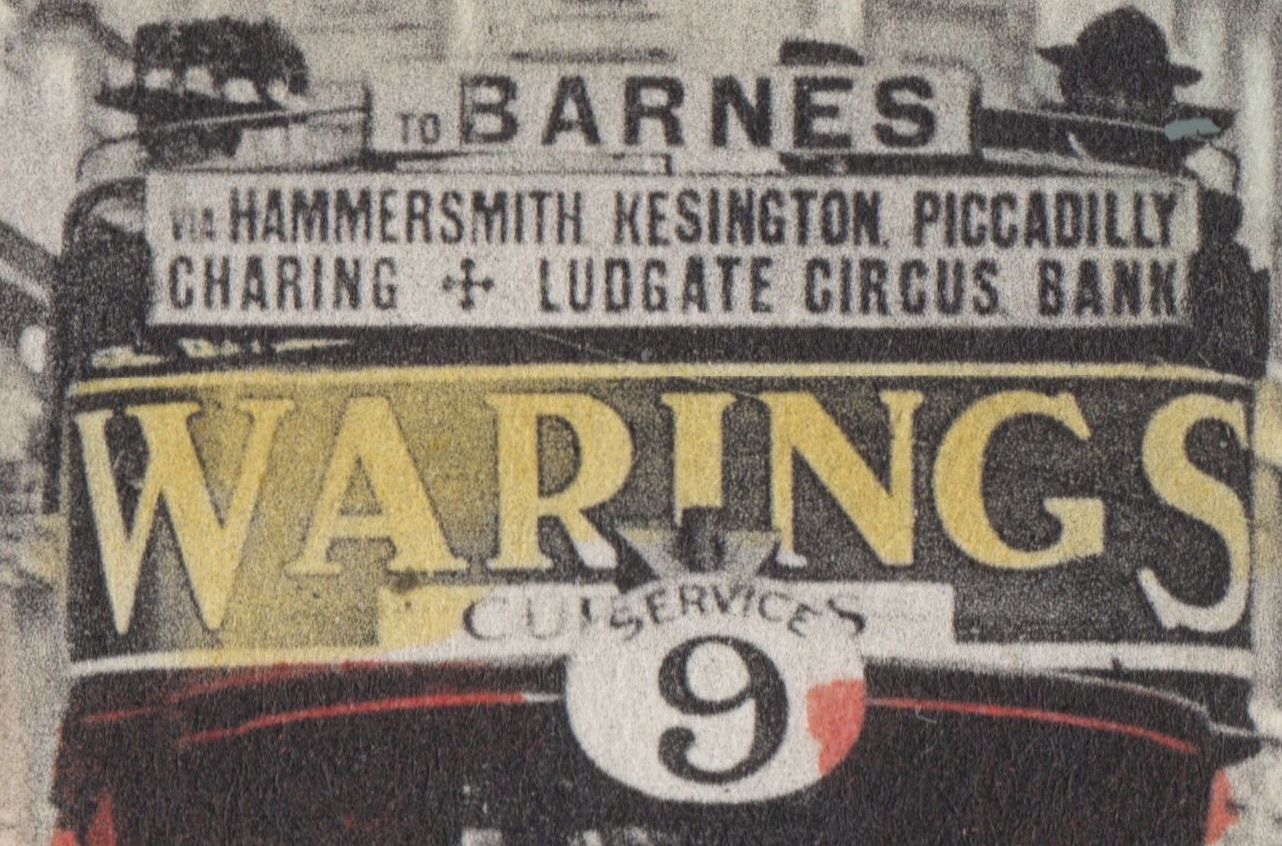
Thanks to German printing technology, this is an unusually well produced postcard with a detailed image of London buses posed outside the Bank of England. A somewhat diffident constable holds up the traffic alongside a young messenger boy who succeeds in occupying the centre of the picture. A handful of pedestrians stare in a desultory fashion as the camera operator prepares for the shot.  History records that the advertised play, The Ogre by Henry Arthur Jones, opened to lukewarm reviews on September 11th. 1911 at St. James’s Theatre which dates the postcard to the late summer of 1911.

Route 7's history can be traced back to 1 November 1908, when an un-numbered daily route operating between Wormwood Scrubs and Liverpool Street station, was allocated route number 7. Today’s route 7 connects East Acton with Oxford Circus. Route 9 is one of several claimants to the title of London’s oldest bus route, dating back to 1851. In its present form it runs between Hammersmith and Aldwych. Both routes are a lot shorter than in their heyday and neither penetrate as far east as Bank, making this an unrepeatable encounter. Pedantic note - both buses display spelling mistakes. An extra letter B has been added to Wormwood Scrubs on the 7, while the first letter N has been omitted from the word Kensington on the 9.