Sunday, 29 September 2024

Jane Parminter and A la Ronde

In 1784, at the age of 34, Jane Parminter having recently inherited her father’s estate embarked on a Grand Tour of Europe with three companions, her sister Elizabeth, her cousin Mary and another female friend. Their travels would last almost ten years and although Jane kept a detailed journal, all but the first volume were destroyed in the Baedeker bombing of Exeter.  What details we have of their itinerary has been extrapolated  from the significant quantity of paintings, prints and souvenirs they brought home. It seems certain that they explored France, Germany, Switzerland and Italy and likely that they also took in Spain and Portugal (Jane was born and spent her early years in Lisbon where her wine merchant father had his own business). 

As expedition leader, Jane had revealed an unusual strength of character and defied the limitations that polite society routinely imposed on unmarried females. She and her cousin Mary had become firm friends and resolved on their return to build a new house of their own specification in which to share their lives. In 1796 Jane bought a parcel of land on high ground between Exmouth and Lympstone, with a panoramic view of the Exe Estuary.  The plan for the 28 acre plot was to build a house of their own design, create a 'ferme ornée' (or ornamental farm), and establish a school for girls from disadvantaged backgrounds. There’s no settled view on just who was responsible for the design or the plans from which the house was built - the 16 sided floor plan must have come from Jane and the many affinities with the Basilica of San Vitale, Ravenna (which made a powerful impression when they visited) in spatial organisation likewise.  Few practising architects would have contemplated such a radical departure from convention.

The completed house became a base for their philanthropic activities, a refuge from a male dominated world and above all a treasure box for all the memorabilia gathered on their travels where much time had been spent staring into cabinets of curiosities and dreaming of creating their own.  Daily life would never have been straightforward in such an unusual layout which left oddly shaped rooms and difficult spaces for staircases.  But they persevered, ignored the discomforts and gradually populated the spaces and decorated the walls to schemes entirely of their own devising.  This sense of autonomy and freedom from masculine interventions was crucial to the plan - it was their good fortune that the Parminter and Walrond inheritances made it all possible.

Best known of all their schemes is the Shell Gallery at the very top of the house - nobody knows how long they spent in a very cramped space, collaging sea shells in multiple configurations across eight separate surfaces or whether it was all done unassisted. But the sheer scale of ambition and endeavour is compelling, though the installation is now too fragile for visitors to inspect. It has recently been repaired and spruced up and the process was broadcast by the BBC in April this year.  When Jane died in 1811 she left the property to her cousin Mary on the condition that it could only be bequeathed to an unmarried female relative. That condition was honoured on the death of Mary in 1849, not until 1887 would the condition be rescinded and a male heir take possession.  This lead to a programme of modernisation that included replacing the thatched roof with slates, installing Dormer windows in the upstairs rooms, introducing central heating (hence the massive radiators seen in the photo) and obtaining a Dumb Waiter to bring meals from the kitchen  to the upper level, thus avoiding the restrictive staircase.

This story of female agency and empowerment is especially fascinating today to all who share concerns about gender imbalance - Jane Parminter exhibited a firm resolve to be unconstrained by male expectations of female conduct in an age where the rights of women came second to their status as male property. That it left a deep scar can be seen in Jane’s determination that no man should get his hands on the home she had worked so hard to create.  A la Ronde is the monument to her singular independence, strength of character and intellectual sensibility. 


Friday, 20 September 2024

Pioneers of German Graphic Design - Part Two

This is the long promised follow-up to the post of May 26. A further selection from the book, Pioneers of German Graphic Design, Callisto Publishers Berlin, 2017 (ISBN: 9783981753912) featuring Karl Schulpig to Jupp Wiertz plus an appendix of less well known designers.  The visual ingenuity and graphic impact of these images have lost none of their power over the years and will continue to serve as a vital source of inspiration for generations to come.  A superb book that I shall never tire of browsing.


Friday, 23 August 2024

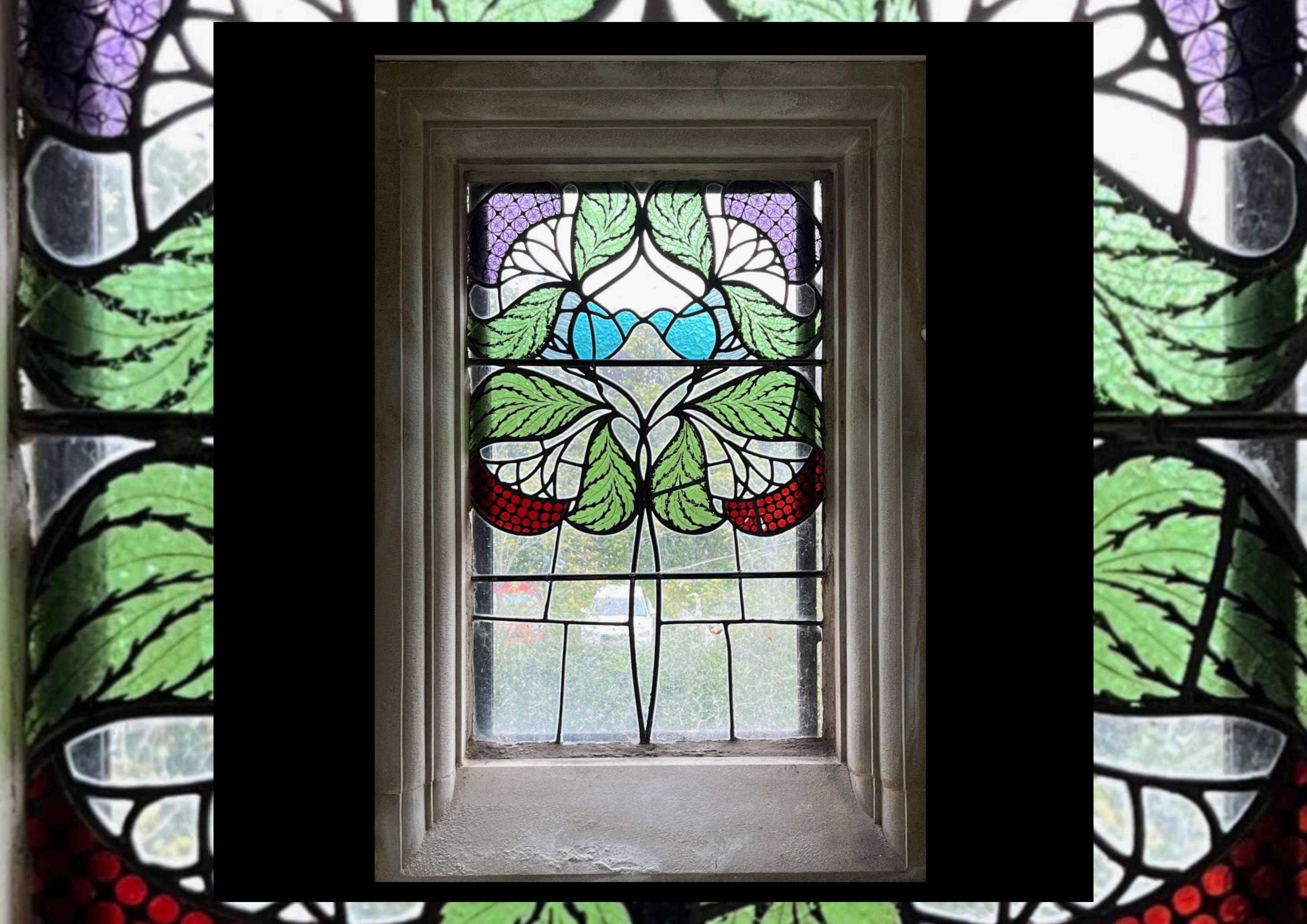
Blackwell Stained Glass

One of the glories of Baillie Scott's masterpiece, Blackwell, built 1898-1900 for the Manchester family of brewers - the Holts, is the generous provision of stained glass mullioned windows, often paired in inglenooks or punctuating  long corridors. Their designs express a sense of joy at the beauty and transience of the natural world where  everything appears to be in motion - flowers sway in the breeze, semi-abstracted bluebirds swoop from treetop to roof top.  All is elegantly stylised in clusters of intersecting curves, organised in dynamic compositions.  Smaller and cruder versions of these motifs can be found on many an interwar suburban front door, often in combination with rustic cottages with woodsmoke curling up into the clouds. Disappointingly I can find no online information about who designed these windows or who supplied them. Simpson’s of Kendal could have been the supplier but there’s no confirmation of this. It must be possible they were simply ordered from a catalogue though the design incorporating the Holt Coat of Arms must have been a special commission.


Thursday, 22 August 2024

Blackwell, Windermere

It’s often intriguing to compare the grandeur of the big house bought with the fruits of entrepreneurship with the circumstances of the consumers whose discretionary spending was the source of the fortune that paid for it. In the case of the Holt family of Mancunian brewers the contrast with the coarse and smoke-filled Public Bar favoured by the Lancastrian working man could hardly be greater.  Blackwell was a summer residence built 1898-1900 in a wonderful position on the heights overlooking the eastern shore of Windermere where the extended family would gather in the pursuit of leisure.  A long and elevated terrace offered glorious views of the lake and hills beyond while the house was designed for spacious comfort in artistically uplifting interiors. For the architect, Baillie Scott, this was his first major commission since returning from self-imposed ‘exile’ on the Isle of Man and a great opportunity to showcase his individual vision of Arts and Crafts domestic building alongside his talent as an impresario, bringing together brilliant designers and highly skilled craft workers to enhance his vision with wonderful stained glass, wall coverings and fixtures and fittings - no detail overlooked or left to chance. 


A double height Main Hall, approached via a long low corridor has a medieval flavour.  Around the oak panelled walls runs an exquisite carved frieze by Simpson of Kendal based on a rowanberry motif. Above is the wallpaper, Peacock Frieze, supplied by Shand Kydd. Six copper lamp fittings designed by Baillie Scott were installed to illuminate the family billiard table. Scott’s design for the Great Hall was closely based on his competition entry for a House for an Art Lover (“Haus Eines Kunstfreundes” ). A corner staircase rises to the bedrooms and a minstrels’ gallery. The Holt family would pass their leisure time in the Main Hall where beneath a coffered ceiling - French windows gave on to the garden. The hall led into the dining room with its fireplace inglenook, a favourite device of Baillie Scott’s, surmounted by a massive lintel formed from voussoirs of local stone and slate. Beautiful stained glass with floral and bluebird motifs added elegance to the sense of enclosure.


The White Drawing Room is a theatrical coup, approached along the same gloomy oak lined corridor it marks a thrilling transition to a sudden flare of evening sunshine with panoramic views of the lake below. Beneath another Rowanberry Frieze inside another inglenook is the finest fireplace in the house embellished with stained glass, ceramic tiles, mosaic floor, ornamental fire dogs, alcoves, mirrors and white painted slender columns topped with capitals of carved birds, fruits and leaf motifs. Female dinner guests were obliged to withdraw to the White Room while the alpha males gathered round the billiard table - I think the ladies got the better deal. At this point in his career Scott was still absorbing the influence of Voysey and introducing local vernacular elements (cylindrical chimneys, slate roof, multiple gables) into his design for the exterior. The completed house has a commanding presence in the landscape and the positioning of windows and whitewashed rough-cast stone finish invited comparisons with another influential figure - Mackintosh (Hill House was completed in 1904) are often evoked and the two architects were stylistically close at the time. Both entered the competition to design a House for an Art Lover organised by the German design magazine “Zeitschrift Für Innendekoration”.  Baillie Scott was awarded second prize and Mackintosh, who had failed to follow the brief, nonetheless obtained a special award.


 In a future post we’ll take a closer look at the use of stained glass at Blackwell.


Wednesday, 14 August 2024

Harold Harvey, painting everyday life


This summer’s exhibition at Penlee House, Penzance was devoted to the paintings of Harold Harvey, the only Cornish born artist associated with the Newlyn circle of painters led by Stanhope Forbes and Laura and Harold Knight.  Harvey was an accomplished constructor of convincing figure compositions, ever alert to the awkwardness, discomfort or tension in the individuals portrayed.  Small social gatherings and domestic scenes were minutely observed and described in detail with particular attention to choices of clothing and facial expressions.  Furnishings and decorative accessories in the home came under similar scrutiny. The work of the intensively observed fishing fleet held little interest and he saw the world of the countryside through the lens of manual labour.  Most Newlyn painters ignored the industrial aspect of Cornish life, unwilling to confront the violence done to the local landscape by the activities of extractive industry, notably the excavation of China Clay and the mining of tin and copper.  Distractions of the modern world of popular entertainment and the transport revolution were studiously avoided by almost all local artists but Harvey kept returning to these subjects throughout his career.  Several of his finest paintings - featuring sunbathers and swimmers, girls outside the cinema, travellers on the top deck of a bus - were a product of this fascination.


His figure drawing was uneven in quality, lacking the bravura of Laura Knight or the conviction of Stanhope Forbes, flabbiness kept creeping in. In the 1930s, under the influence of contemporary trends (Stanley Spencer?), he cautiously experimented with figure distortion and elongation to especially good effect in the bathers painting (August 1939).  Two conflicting tendencies can be seen in his use of colour where a preference for clear, vibrant hues applied with firm, controlled brushwork existed alongside a drift into more pastel hues and softer, Renoir-influenced application of paint.  The latter technique being more apparent in portraiture, especially of child subjects.  The key element in his subject choices is his local origin - incomers and outsiders fell heavily for the most picturesque features of Cornish life (fishing, farming and a ravishing coastline in dazzling sunshine).  For Harvey these aspects were taken for granted and he rarely turned to them.  His eyes were focused on a localised experience of everyday life - the domestic middle class interior, the world of work and manual labour, the arrival of mass tourism. Inside the home he was an acute observer of the enigmatic gesture, the unusual body posture and the ambivalent glance, sometimes hinting at an underlying disquiet or noting the vagaries of fashion and the faintly absurd.  Friends and acquaintances described him as affable and good natured, though somewhat taciturn.  In later life he converted to Catholicism but nothing of his spiritual life made its way into his work which remained resolutely materialist.