Postcard dealers are of necessity, dedicated classifiers and organisers, with every card in its rightful place. But most will offer a box or two of unsorted low value cards and these are my favourite hunting grounds. This is where images like this often turn up. If it was filed under Germany that somehow seems inadequate but nobody has a category entitled Enigmatic Images of People Climbing – thus it can be found languishing among the unloved and unsorted. This card demands an explanatory narrative but the few facts we have don’t easily resolve themselves. Is there a relationship between the two figures? The climbing man in a cap seems to be in a hurry – is he in pursuit? If so, his gaze is directed elsewhere than at his quarry. The occupant of the platform poses rigidly by the safety rail and exhibits no concern about the approaching figure. Two bonus cards show the ascent of the Great Pyramid. On the left visitors from the lands of the infidel are offered assistance by the indigenous population while on the right a group of locals show (as the caption puts it) how easy it is to ascend. Both are typical examples of the early postcard photographer placing the figures in position as if in a theatrical tableau.
Friday, 10 August 2012
Saturday, 4 August 2012
Zurenborg, an Antwerp Suburb
A 15 minute tram-ride from the city centre past the wondrous Central Station and on for another two miles via a long, narrow street of small, struggling and deceased businesses leads to the Draakplaats intersection, then under the railway bridge and into the heart of the strange fin-de-siécle suburb of Zurenborg. These photos come from the Cogels-Osylei district that takes its name from those of the agricultural landowners who spotted an economic opportunity as the city encroached upon their farmland in the 1890s. Although the suburb was developed according to a carefully considered master-plan, the plan did not extend to imposing conformity of architectural style. Instead, local architects and builders created a show-ground offering examples of the newest of contemporary styles alongside every conceivable historical revival to attract a professional and prosperous clientele. Mansion blocks and large townhouses line the silent streets and compete for attention with a spectacular variety of façades applied over mostly conventional interiors. Some developments conformed to a theme – examples include the Four Seasons (described in a post last October), the group of five houses themed according to times of the day, known collectively as Den Tijd (time) and the houses in Waterloostraat that commemorate the Napoleonic wars. A sense that the stylistic eclecticism was driven by commercial considerations has divided architectural critics with many tending to dismiss it as a theatrical exercise of no great merit. This seems to me to miss the point – which is that a happy accident of time, place and motivation has produced a unique, three-dimensional architectural pattern-book for our enjoyment and a perfect illustration of the way that architects simultaneously attempt to look both forward and backwards and achieve some sort of balance. Two brief visits is not enough to put together a comprehensive study – these images are no more than a partial glimpse and to get a better feeling for the innate incongruity, present for the most part a sequence of window surrounds offering a dazzling range of forms and finishes.
Labels:
antwerp,
architecture,
art nouveau,
belgium,
zurenborg
Thursday, 2 August 2012
Yellow Door
Two photographs of the same subject taken 5 years apart. The first was taken by my wife Liz in December 2003 in the West Dorset coastal village of Seatown on our very first expedition with a digital camera (late adopters). Liz has a far better eye for a potential picture than I do and she was quick to see this freshly painted door shaped like an arrowhead launching into a stunning blue sky. My photo came 5 years later in December 2008 and illustrates how half a decade’s exposure to sunshine and sea-spray has faded the pigment and attacked the paint surface.
Wednesday, 1 August 2012
Britain grabs Olympic Gold in Whingeing
Britain’s whingers put a smile back on the nation’s face after a sensational triumph in last night’s whingeing finals in the face of strong opposition from, of all countries, the United States. Team GB walks tall this morning having surged to position 48 in the Medals Table. The US challenge was masterminded by Head Coach Mutt Romney, who cast aside his compatriots’ habitual manic optimism and in an audacious move, outsourced the team effort to the Tea Party cult. They came up with some epic whingeing on the subjects of immigration, welfare, taxation, abortion, gay marriage and the great American surrender to Socialism and looked to have established a winning position. But the British fight-back was awesome – the Dream Team (Baroness Warsi, Eric Pickles and “Wee” Danny Alexander) showed their class with some wonderful whingeing directed at disability claimants, welfare scroungers, public sector parasites and the last Labour government’s appalling financial legacy, concluding in a high-risk strategy with a whinge about their fellow atherletes’ frailty in the field of combat and their miserable haul of medals. Romney’s team responded instantly with a spectacular whinge about the innate British capacity for whingeing, an unfair advantage achieved by generations of unchallenged supremacy. Spirits sank in the British team and all seemed lost until sprint-whingeing specialist (and Team Captain), Michael Gove came to the crease and unleashed a volley of whingeing on the subject of education. Spectators were stunned when he reminded them that not a single British school-leaver was capable of building a Large Hadron Collider without assistance or counting to a million in Roman Numerals. Skipper Gove took whingeing to a new level with a bitter complaint about the national cult of educational mediocrity which had brought this once-proud nation to financial ruin. Judges were unanimous – Gove had inspired Britain to an unassailable position and Gold was, at last, within our grasp. On a sad note, Romney was less than gracious in defeat and questioned the entire basis of the British triumph claiming, “Yeh, the Brits were good, but they got some questions to answer. What we saw tonight was whingeing at the limits of human endurance. I’m not saying these guys were on anti-euphorics and depressants but someone needs to find out the truth.”
A Phil Space exclusive from our man in the empty seat.
Tuesday, 31 July 2012
Under Limestone Hills
“There was a rocky valley between Buxton and Bakewell, once upon a time, divine as the Vale of Tempe... You Enterprised a Railroad through the valley - you blasted its rocks away, heaped thousands of tons of shale into its lovely stream. The valley is gone, and the Gods with it; and now, every fool in Buxton can be in Bakewell in half an hour, and every fool in Bakewell at Buxton; which you think a lucrative process of exchange – you Fools everywhere.”
John Ruskin, master of self-righteous Victorian bombast, thus addressed the British working-man in the pages of Fors Clavigera. Ruskin’s professed admiration for the dignity of labour did not extend to the itinerant labourers who toiled mightily on behalf of the Midland Railway carving cuttings through the limestone, drilling tunnels through the hills and bridging the rivers with viaducts, linking the fools of Buxton with their counterparts in Bakewell. After just over a century of trains from St. Pancras to Manchester, the railway that so offended Ruskin was closed in 1968. Subsequently the track-bed was converted into a footpath and bridleway (Monsal Trail) in the care of the Peak District National Park Authority. In May of last year the Park Authority completed a project to modify the former railway tunnels for public access and in doing so, eliminated the need for some lengthy diversions and greatly enhanced the walking experience.
The subject of tunnels is one we keep returning to, offering fascination on a number of levels. Walking through tunnels it’s difficult to ignore the fact that these are places we are not meant to be in – deep in the earth, encircled by rock and scree and far from the nearest source of natural light. Then there’s the sheer volume of labour involved in construction, with primitive tools in conditions of terrifying discomfort. An enormous price was paid in terms of the amount of injury and accidental death inflicted upon the unprotected workforce. All this melancholia hovers in the back of the mind as we trudge from portal to portal through the chill and humid semi-darkness but nothing dispels it so rapidly as the need to take urgent evasive action as an army of super-fast cyclists sweep past. The risk assessments and safety cases have all been duly observed, damp proof overhead lighting has been installed and a tarmac path offers relief from the scrunchy ballast. A sooty, black squelchy gunk adheres to the tunnel lining and offers a reminder of its former existence – a notice warns of the damaging consequences of transferring this toxic post-industrial slurry to our lips.
Labels:
monsal trail,
railways,
tunnel,
walking
Monday, 23 July 2012
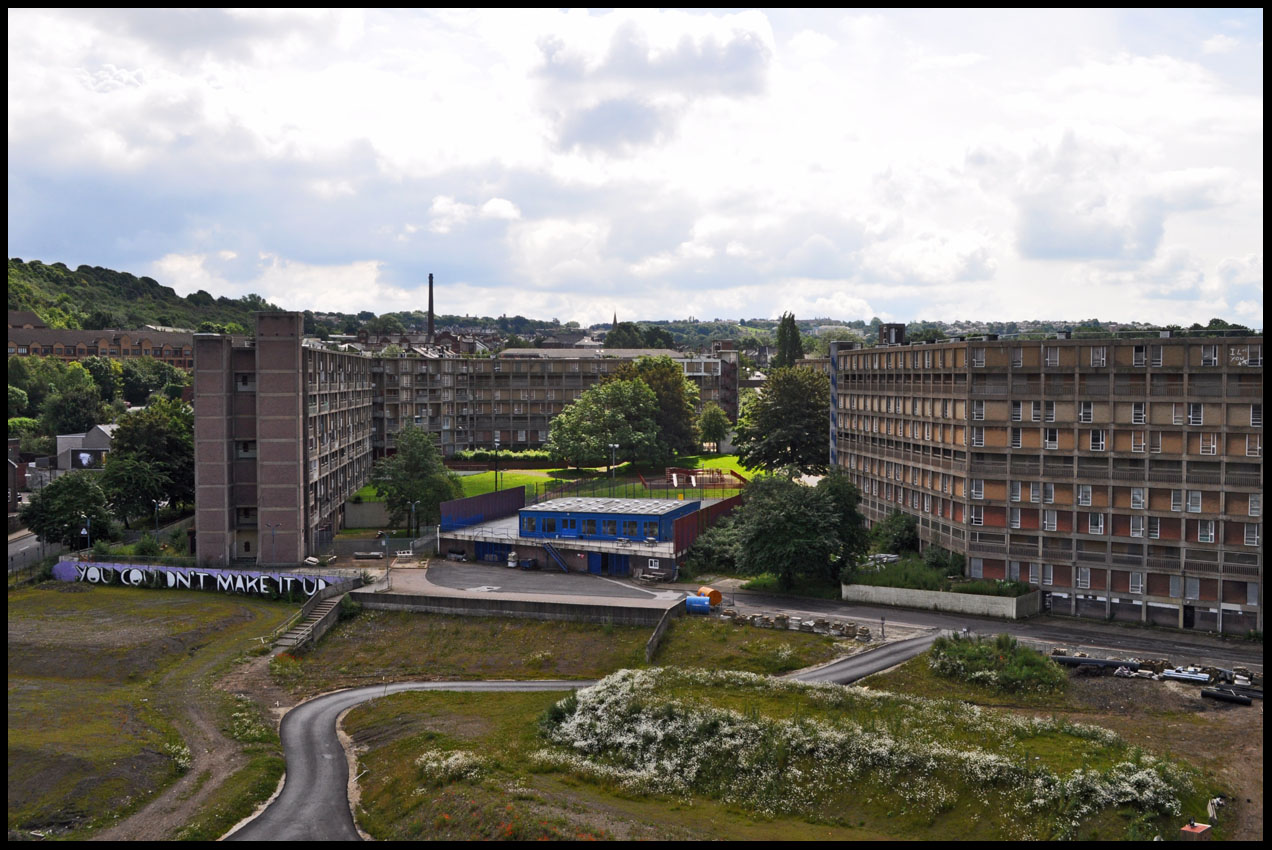
Park Hill – Utopia Remodelled
Most utopian visions go into gentle decline as the years pass by but Park Hill in Sheffield, like many high-rise social housing developments, fell from grace at speed. The fame it now enjoys is a product of its dramatic domination of the city skyline and the scale of ambition, all the more striking in a culture where the preference is for modest, provisional, interim, incremental solutions to housing needs. It was a major statement that reflected the city’s self-confidence. Almost 3,500 residents were accommodated here when the buildings were completed in 1961 but as the novelty wore off it became an increasingly unpleasant place to live – poor maintenance, sound insulation issues, sub-standard materials and anti-social behaviour all contributed. The argument about responsibility for this goes on – target-obsessed city planners insensitive to the needs of families with children, architects with grandiose ambitions, constant downward pressure on housing budgets and feckless tenants have all attracted blame from one quarter or another.
Fifty years having passed since completion, the scheme fits a historic narrative that leads back to Marseille and le Corbusier’s Unité d’Habitation and to the Karl-Marx-Hof in Vienna. The linked access decks (streets in the sky) at every third level caught the public imagination and the buildings attracted admirers and detractors in equal measure until in 1998 English Heritage awarded grade II* listing. Fourteen years later, only the southernmost low-rise buildings remain occupied by council tenants. The greater part of the scheme is vacant with the initial phase of refurbishment and internal remodelling by developers Urban Splash (closely monitored by English Heritage) nearing completion. The first block to be finished should be ready for occupation in December and a sales campaign is underway. The campaign must contend with a generalised cultural antipathy to concrete and high-rise (brutalist, unsympathetic, inhuman scale, anti-individualist, un-English) and additional hostility from enemies of the “heritage industry” and opponents of gentrification.
When you go inside, you find yourself trying to imagine exactly what it would be like to live there when the fascination of the spectacular views begins to fade into dull familiarity. Storage space is minimal, so a spare and austere lifestyle would be an advantage. An occupant with acquisitive habits would rapidly come up against the limits of what could be accommodated in rooms of modest dimensions. The original room plans were designed to Parker Morris standards – practical for 1961 but incompatible with the world of home cinema, jumbo-size fridge-freezers, walk-in wardrobes and wet-rooms. These confined spaces will have little appeal for the young professional looking forward to rolling out a four-seater leather sofa and a runway sized coffee table in a city centre loft apartment. Perhaps there’s a developing market for Modernism as nostalgia – a place where the coarse texture of brutalism serves as a corrective to the dazzling surface gloss of corporate aggrandisement. Will the rectilinear Modernist rhythms of horizontal and vertical elements appear models of restraint when compared with the computer-designed formal travesties that tower over the Gulf states or the Shards and Gherkins to be found closer to home?
Labels:
architecture,
modernism,
sheffield
Monday, 2 July 2012
Le Train Bleu
The name and the illuminated sign recall the great inter-war era of luxury rail travel but inside the restaurant at the Gare de Lyon all is Belle Époque. The Gare de Lyon was a prestige project timed to coincide with the Exposition Universelle in 1900 and the restaurant ambience is one of unrestrained glittering opulence – swags, cartouches, escutcheons, and super-size chandeliers vie for attention. Walls and ceilings are decorated with huge Salon-style paintings representing destinations served by the PLM while lascivious nude figures lounge around wrapped in a slick layer of gold leaf. Leather upholstery, fine cutlery and glassware, and condescending service from supercilious staff complete the picture.
Subscribe to:
Posts (Atom)